
Crock
1936
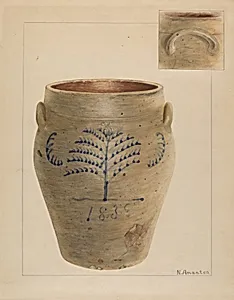
Medium
watercolor, graphite, and colored pencil on paperboard
Dimensions
overall: 29.2 x 23.2 cm (11 1/2 x 9 1/8 in.) Original IAD Object: 13" High 9 3/8" Dia(top) 6 5/8" Dia(base)
Classification
Index of American Design
Department
CG-W
Museum
National Gallery of Art, Washington, D.C.
Credit
Index of American Design
Accession Number
1943.8.6383
Rights
Public Domain
Art Historical Context
In the heart of the Great Depression, artist Nicholas Amantea captured the humble elegance of everyday American life with *Crock* (1936), a rendering now housed in the National Gallery of Art. Created as part of the Index of American Design Federal Art Project under the Works Progress Administration (WPA)—this watercolor, graphite, and colored work on paperboard (29.2 x 23.2 cm) depicts a classic stoneware storage vessel, or crock, standing 13 inches high with a 9 3/8-inch top diameter tapering to 6 5/8 inches at the base. These utilitarian pots, often used for preserving butter, pickles, or grains, embodied the sturdy craftsmanship of 19th-century American potters. Amantea's piece exemplifies the Index's mission: to document and celebrate the nation's folk art and design heritage through over 18,000 precise, colorful illustrations. His technique blends realistic graphite underdrawing with vibrant watercolors and colored pencil highlights, bringing the crock's glossy cobalt-blue glaze and subtle imperfections to life. This not only preserves vanishing artifacts but highlights their cultural role in rural households, where functionality met artisanal pride. Today, *Crock* invites visitors to appreciate how ordinary objects reflect America's inventive spirit, bridging colonial traditions with modern recognition. A testament to WPA-era creativity, it reminds us that beauty often hides in the everyday.
About the Artist
Nicholas Amantea · 1900–1978
Nicholas Amantea (1900–1978) was an American artist born on July 13, 1900, in Pittsburgh, Pennsylvania. His early life and artistic training are not well documented, but by the mid-1930s, he had established himself in New York City, where he contributed significantly to federal art initiatives during the Great Depression. From March 13, 1936, to July 15, 1942, Amantea worked for the Works Progress...