
Crock
c. 1936
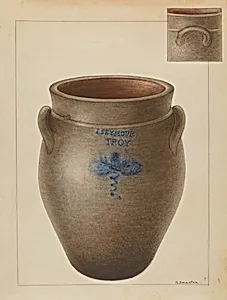
Medium
watercolor, graphite, colored pencil, and heightening on paperboard
Dimensions
overall: 29.9 x 22.5 cm (11 3/4 x 8 7/8 in.) Original IAD Object: 11 1/8" High 8 1/8" Dia(top)
Classification
Index of American Design
Department
CG-W
Museum
National Gallery of Art, Washington, D.C.
Credit
Index of American Design
Accession Number
1943.8.6493
Rights
Public Domain
Art Historical Context
Nicholas Amattea's *Crock* (c. 1936) is a meticulous rendering of a traditional American earthenware storage jar, capturing its sturdy form and subtle glazing in exquisite detail. Created as part of the Index of American Design (IAD), this watercolor, graphite, colored pencil, and heightening on paperboard measures 29.9 x 22.5 cm, faithfully documenting an original object standing 11 1/8 inches high with an 8 1/8-inch top diameter. Housed in the National Gallery of Art, it exemplifies the IAD's mission to celebrate everyday American craftsmanship. Produced under the Federal Art Project of the Works Progress Administration (WPA) during the Great Depression, the IAD employed over 400 artists to produce some 15,000 watercolor renderings of folk art, design objects, and decorative arts from across the U.S. Amattea's contribution highlights the humble crock—a ubiquitous vessel for preserving food in colonial and frontier households—as a pinnacle of vernacular design, blending utility with artisanal skill. The mixed-media technique allows for luminous color washes in watercolor, precise line work in graphite and colored pencil, and metallic heightening to evoke the crock's tactile surface and sheen. This approach not only preserved vanishing artifacts but elevated them to fine art status, fostering national pride in America's material culture during challenging times. A testament to ingenuity, *Crock* invites us to appreciate the poetry in the practical.
About the Artist
Nicholas Amantea · 1900–1978
Nicholas Amantea (1900–1978) was an American artist born on July 13, 1900, in Pittsburgh, Pennsylvania. His early life and artistic training are not well documented, but by the mid-1930s, he had established himself in New York City, where he contributed significantly to federal art initiatives during the Great Depression. From March 13, 1936, to July 15, 1942, Amantea worked for the Works Progress...