
Cross
1550–1600
Medium
Boxwood
Dimensions
Overall: 16 7/8 x 4 x 3 1/16 in. (42.9 x 10.2 x 7.7 cm) base only: 8 9/16 x 3 7/16 x 3 1/16 in. (21.7 x 8.8 x 7.7 cm) cross only with shaft: 12 13/16 x 4 x 1 in. (32.5 x 10.2 x 2.6 cm) cross without shaft: 8 1/8 x 4 x 1 in. (20.6 x 10.2 x 2.6 cm)
Classification
Sculpture-Wood
Culture
Byzantine
Department
Medieval Art
Museum
Metropolitan Museum of Art, New York, NY
Credit
Purchase, Giorgi Family Foundation Gift, 2019
Accession Number
2019.559a, b
Rights
Public Domain
Art Historical Context
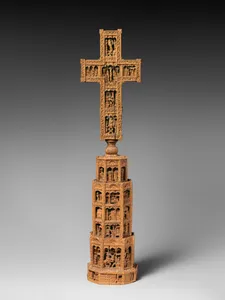
This exquisite wooden cross, crafted by the Byzantine artist Giorgios Lask (also known as George Laskaris between 1550 and1600, exemplifies the religious artistry of the post-Byzantine Orthodox world. Carved from boxwood—a dense, fine-grained wood for its ability to hold intricate details—this sculpture measures 16⅞ x 4 x 3⅛ inches overall, with separate base and detachable shaft, suggesting a modular design for portability or liturgical use. In the context of Byzantine culture, such crosses held profound spiritual significance, often serving as focal points in processions, altars, or personal devotion. Laskaris's work reflects the meticulous carving techniques of the period, where boxwood's smooth texture allowed for precise reliefs and symbolic motifs, bridging medieval traditions with Renaissance-era refinements. Though specific iconography details are subtle in this format, the object's craftsmanship underscores the Orthodox emphasis on sacred objects as conduits of divine presence. Acquired by the Metropolitan Museum of Art in 2019 through the Giorgi Family Foundation, this cross invites visitors to appreciate the tactile beauty of Byzantine wood sculpture, a testament to faith and artistry that survived centuries.