
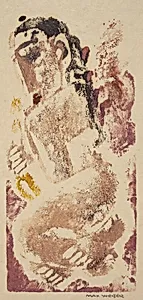
Crouching Nude
1919-1920
Medium
color woodcut on laid paper
Dimensions
image: 10.2 x 4.8 cm (4 x 1 7/8 in.) sheet: 23.8 x 15.9 cm (9 3/8 x 6 1/4 in.)
Classification
Department
CG-W
Museum
National Gallery of Art, Washington, D.C.
Credit
Print Purchase Fund (Rosenwald Collection)
Accession Number
1976.61.2
Rights
Public Domain
Art Historical Context
Max Weber’s “Crouching Nude” (1919–1920) is a compact yet powerful color woodcut that reflects the artist’s pioneering role in bringing European modernism to American audiences. Weber, who had studied in Paris and absorbed the lessons of Cubism and Fauvism, used the woodcut’s bold, angular lines and layered colors to distill the human figure into essential geometric forms. The intimate scale—barely four inches tall—encourages viewers to lean in, turning the act of looking into a quiet, concentrated encounter with modernist form. Color woodcuts were still relatively uncommon in the United States at the time, and Weber’s choice of medium underscores his experimental spirit. By carving separate blocks for each hue and printing them on laid paper, he achieved a vibrant yet graphic effect that emphasizes rhythm and structure over naturalistic detail. Acquired through the Rosenwald Collection, the print stands as a fine example of early twentieth-century American printmaking’s embrace of both technical innovation and the expressive possibilities of the human body.
About the Artist
Max Weber · 1881–1961
Max Weber (1881–1961), born in Białystok in the Russian Empire (now Poland) to Orthodox Jewish parents, immigrated to Brooklyn, New York, at age ten with his family, joining his tailor father.) There, he pursued art studies at the Pratt Institute under Arthur Wesley Dow, an innovative teacher who emphasized expression and form over traditional narrative, drawing from Japanese art and Paul Gauguin....