
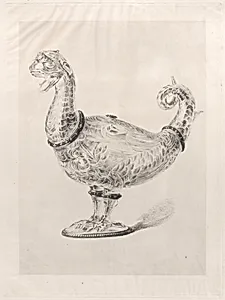
Crystal Ewer
Medium
Etching
Dimensions
Sheet: 19 11/16 × 14 3/8 in. (50 × 36.5 cm) Plate: 15 3/8 × 11 1/4 in. (39 × 28.5 cm)
Classification
Prints
Department
Drawings and Prints
Museum
Metropolitan Museum of Art, New York, NY
Credit
Gift of Howard Mansfield, 1917
Accession Number
17.6.9
Rights
Public Domain
Tags
Art Historical Context
Behold the exquisite *Crystal Ewer*, an 1864 etching by French artist Jules-Ferdinand Jacquemart, a master of the 19th-century etching revival Jacquemart, celebrated for his meticulous reproductions of decorative arts, captures the delicate facets and luminous transparency of a crystal pitcher with astonishing precision. Measuring 15 3/8 × 11 1/4 inches on the plate, this print exemplifies his ability to translate the sparkle of glass into intricate lines evoking the opulence Second Empire France. Etching, Jacquemart's favored medium, allowed him to achieve Rembrandt-like depth through acid-bitten lines on a metal plate, rendering textures from smooth crystal curves to subtle reflections. Produced during a era when prints democratized access to luxury objects, this work highlights the cultural fascination with ornate glassware—ewers like this symbolized refinement in elite dining. A generous gift to the Metropolitan Museum of Art from collector Howard Mansfield in 1917, *Crystal Ewer* resides in the Drawings and Prints department. It invites visitors to marvel at how a simple print can preserve the elegance of a bygone treasure, bridging art and craftsmanship across centuries.
About the Artist
Jules-Ferdinand Jacquemart · 1837–1880
**Jules-Ferdinand Jacquemart: Master Etcher and Watercolorist** Jules-Ferdinand Jacquemart was born on September 7, 1837, in Paris to Albert Jacquemart, a prominent art collector, ceramics historian, and amateur artist, and Louise Émilie Labbé. The third of four children, he received his initial training in etching from his father, who had no formal master himself and emphasized self-taught preci...