
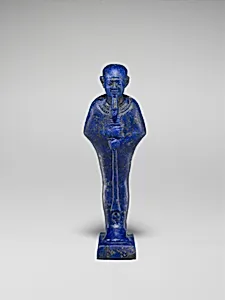
Cult Image of the God Ptah
Unknown Artist
ca. 945–600 B.C.
Medium
Lapis lazuli
Dimensions
Height of figure 5.2 cm (2 1/16 in); w. 1.8 cm (11/16 in); d. 1.1 cm (7/16 in.); Height of dais 0.4 cm (3/16 in); w 1.0 cm (3/8 in); d 1.6 cm (5/8 in)
Classification
Statuette, Ptah
Period
Third Intermediate Period–early Dynasty 26
Department
Egyptian Art
Museum
Metropolitan Museum of Art, New York, NY
Credit
Anne and John V. Hansen Egyptian Purchase Fund, 2007
Accession Number
2007.24
Rights
Public Domain
Tags
Art Historical Context
This exquisite cult image of the god Ptah, carved from luminous lapis lazuli, dates to Egypt’s Third Intermediate Period through the early Twenty-Sixth Dynasty (ca. 945–600 B.C.). Standing just over five centimeters tall on its tiny dais, the figure would have served as the focal point of temple ritual, embodying the divine presence of Ptah—the creator god, patron of craftsmen, and lord of Memphis. In Egyptian belief, such images were not mere representations but vessels that the deity could inhabit during ceremonies. Lapis lazuli, sourced from distant mines in Afghanistan, was prized for its celestial blue hue flecked with golden pyrite, evoking the night sky and eternal divinity. Its use for this miniature sculpture underscores the object’s sacred status; even small cult figures received offerings, were anointed, and were carried in processions to renew cosmic order. The compact scale suggests it may have belonged to a portable shrine or a high-status individual’s private devotion. Today housed in the Metropolitan Museum of Art, this delicately worked figure invites visitors to imagine the intimate scale of ancient Egyptian worship, where precious materials and meticulous craftsmanship transformed a tiny stone into a living link between the human and divine realms.