
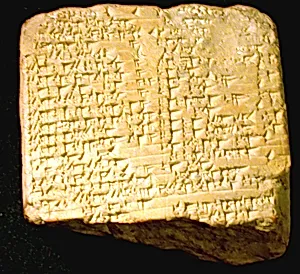
Cuneiform tablet: Utu-gin e-ta, balag composition addressed to Enlil
Unknown Artist
ca. 145 BCE
Medium
Clay
Dimensions
2 3/4 x 2 3/4 x 1 in. (6.9 x 6.9 x 2.5 cm)
Classification
Clay-Tablets-Inscribed
Culture & Period
Seleucid · Seleucid
Department
Ancient Near Eastern Art
Museum
Metropolitan Museum of Art, New York, NY
Credit
Purchase, 1886
Accession Number
86.11.182
Rights
Public Domain
Art Historical Context
This small clay tablet, inscribed with cuneiform script and dating to around 145 BCE, hails from the Seleucid period in ancient Mesopotamia. Crafted during the Hellenistic era following Alexander the Great's conquests it exemplifies the enduring cultural fusion in the Near East, where Greek rulers coexisted with longstanding Babylonian traditions. Measuring just 2¾ x 2¾ x 1 inches, this unassuming artifact—acquired by the Metropolitan Museum Art in 1886—preserves a "balag" composition titled *Utu-gin e-ta*, a poetic lament or prayer addressed to Enlil, the supreme Sumerian god of wind, earth, and. Cuneiform, the world's oldest writing system, was pressed into soft clay with a reed stylus to form wedge-shaped signs, then fired for durability. This technique, refined over millennia, allowed scribes to record everything from laws to literature. The balag genre, rooted in Sumerian temple rituals, often invoked divine intervention amid crisis, highlighting the tablet's role in religious devotion even under Seleucid rule—a testament to the resilience of Mesopotamian spirituality. As a window into daily piety and scribal artistry, this tablet bridges empires, reminding us how ancient voices echoed through clay across centuries.