
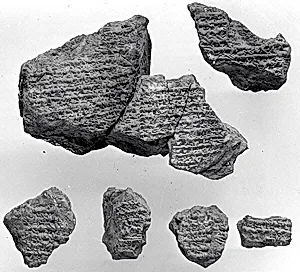
Cuneiform tablet: Utukku lemnutu, tablet 3
Unknown Artist
ca. late 1st millennium BCE
Medium
Clay
Dimensions
5 x 3.75 in. (12.7 x 9.53 cm)
Classification
Clay-Tablets-Inscribed
Culture & Period
Seleucid · Seleucid
Department
Ancient Near Eastern Art
Museum
Metropolitan Museum of Art, New York, NY
Credit
Purchase, 1886
Accession Number
86.11.379a, c–f
Rights
Public Domain
Art Historical Context
Step into the ancient world with this remarkable cuneiform tablet, *Utukku lemnutu, tablet 3*, from the late 1 millennium BCE. Crafted from clay and measuring a compact 5 x 3.75 inches, it hails from the Seleucid—a Hellenistic era blending Greek influences with enduring Mesopotamian traditions following Alexander the Great's conquest. Acquired by the Metropolitan Museum of Art in1886, this inscribed artifact exemplifies the Ancient Near Eastern mastery of wedge-shaped cuneiform script, pressed into soft clay with a reed stylus before firing for durability. The title *Utukku lemnutu* refers to a series of incantations against malevolent spirits, or "evil ghosts," revealing the spiritual concerns of everyday life in ancient Mesopotamia. These texts, part of a longer ritual corpus, were used by exorcists (āšipu) to ward off supernatural threats through precise incantations and rites. Clay tablets like this one served as the era's books, preserving sacred knowledge across generations in libraries and temples. In the Seleucid period (ca. 312–63 BCE), such tablets highlight cultural continuity amid empire shifts, safeguarding Babylonian wisdom into the Hellenistic age. Handling this piece, visitors can almost feel the scribes' urgency to combat the unseen— a timeless reminder of humanity's quest to conquer fear through words etched in clay.