
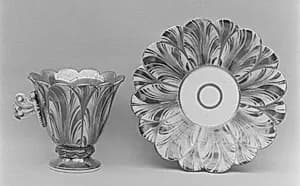
Cup and saucer
Unknown Artist
19th century
Medium
Hard-paste porcelain
Dimensions
Height (cup .5a): 3 3/16 in. (8.1 cm); Diameter (saucer .5b): 5 3/8 in. (13.7 cm)
Classification
Ceramics-Porcelain
Culture
German
Department
European Sculpture and Decorative Arts
Museum
Metropolitan Museum of Art, New York, NY
Credit
Bequest of Margarette A. Jones, 1906
Accession Number
07.233.5a, b
Rights
Public Domain
Art Historical Context
This delicate cup and saucer, crafted in 19th-century Germany from hard-paste porcelain, exemplifies pinnacle of European ceramic innovation. Measuring just 3 3/16 inches tall the cup and 5 3/8 inches across saucer, these diminutive objects were designed for intimate tea or coffee rituals, blending functionality with refined elegance. Hard-paste porcelain, a kaolin-based formula first perfected by German makers like Meissen in the early 1700s, allowed for translucent, durable pieces that rivaled prized Chinese imports—once a closely guarded secret that sparked industrial espionage across Europe. By the 19th century, such tableware had become a hallmark of bourgeois comfort and national pride in Germany, produced in factories for everyday luxury. Though the artist remains unknown, the piece reflects the era's mastery of high-temperature firing techniques, yielding a brilliant white body resistant to chipping and ideal for intricate decoration (even if undecorated here). Housed in the Metropolitan Museum of Art's Department of European Sculpture and Decorative Arts, it entered the collection through the generous 1906 bequest of Margarette A. Jones, preserving a slice of domestic history. Visitors, picture this set gracing a Victorian parlor, whispering tales of transatlantic trade and craftsmanship that elevated the mundane to the magnificent.