
Cup and saucer
1763–74
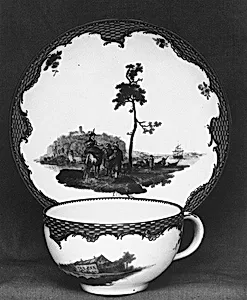
Medium
Hard-paste porcelain
Dimensions
Height (Cup (.1a)): 1 3/4 in. (4.4 cm); Diameter (Saucer (.1b)): 5 1/4 in. (13.3 cm)
Classification
Ceramics-Porcelain
Culture
German, Meissen
Department
European Sculpture and Decorative Arts
Museum
Metropolitan Museum of Art, New York, NY
Credit
Gift of Rev. Alfred Duane Pell, 1913
Accession Number
13.50.1a, b
Rights
Public Domain
Tags
Art Historical Context
This delicate cup and saucer, crafted by the renowned Meissen Manufactory in Germany between 1763 1774, exemplifies the pinnacle of 18th-century European porcelain. Meissen, founded in 1710 as Europe's first producer of true hard-paste—a durable, translucent material rivaling prized Chinese imports—revolutionized decorative arts. Made from kaolin clay fired at high temperatures, this medium allowed for finely detailed modeling and vibrant overglaze enameling, transforming everyday objects into luxurious confections for the aristocracy. Adorned with charming hand-painted scenes of houses, trees, and human figures, the set evokes idyllic pastoral life, a popular Rococo motif celebrating leisure and nature amid the Enlightenment era. The cup stands just 1¾ inches tall, while the saucer's 5¼-inch diameter invites intimate tea rituals, blending functionality with opulence. A generous gift to the Metropolitan Museum of Art in 1913 from Rev. Alfred Duane Pell, this piece highlights Meissen's enduring legacy in ceramics, where technical innovation met artistic whimsy to define German decorative excellence. Visitors, imagine sipping from this gem in a grand salon—pure elegance in every curve!
About the Artist
Meissen Manufactory · 1710–present
The Meissen Manufactory, established on June 6, 1710, by Augustus the Strong, Elector of Saxony and King of Poland, marked the dawn of true hard-paste porcelain production in Europe. Nestled at Albrechtsburg Castle in Meissen near Dresden, the Royal Polish and Electoral Saxon Porcelain Manufactory arose from alchemical experiments begun in 1708 by physicist Ehrenfried Walther von Tschirnhaus and p...