
Cup Plate
Medium
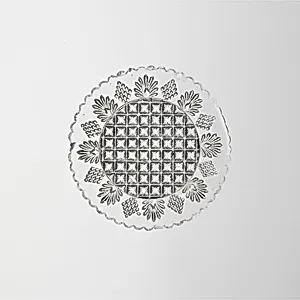
Lacy pressed glass
Dimensions
Dimensions unavailable
Classification
Cup plate
Culture
American
Department
The American Wing
Museum
Metropolitan Museum of Art, New York, NY
Credit
Bequest of Anne Du Pont Peyton, 1944
Accession Number
45.100.37
Rights
Public Domain
Art Historical Context
Nestled in the American Wing of the Metropolitan Museum Art, this *Cup Plate* from the Boston & Sandwich Glass Company (0–50) exemplifies the ingenuity of early American glassmaking. Crafted during a golden age of industrial innovation, the piece hails from the renowned Sandwich Glass Works in Massachusetts, a hub that produced affordable yet elegant tableware for middle-class homes. Cup plates like this one—small saucers about three to four inches across—served a practical purpose: protecting polished tabletops from hot teacups while adding a touch of refinement to everyday meals. The standout feature is its "lacy pressed glass" medium, a technique revolutionized in the 1830s. Molten glass was pressed into finely detailed molds, creating intricate, lace-like patterns that mimicked expensive cut glass but at a fraction of the cost. This democratic approach made decorative glass accessible, reflecting America's growing manufacturing prowess and desire to rival European imports. Though dimensions are unrecorded, such plates were prized for their delicate motifs, often floral or geometric, symbolizing the era's blend of utility and ornament. Bequeathed by Anne Du Pont Peyton in 1944, this artifact invites us to appreciate how ordinary objects embodied 19th-century optimism and craftsmanship, turning the mundane into the memorable.
About the Artist
Boston & Sandwich Glass Company · 1825–1888
The Boston & Sandwich Glass Company, a pioneering force in American glassmaking, was established in 1825 in Sandwich, Massachusetts, by visionary entrepreneur Deming Jarves, who had honed his expertise as an agent for the New England Glass Company in Cambridge. Jarves built the factory on the banks of the Cape Cod Canal, incorporating it formally the following year with Boston investors. Drawing o...