
Cycle Race
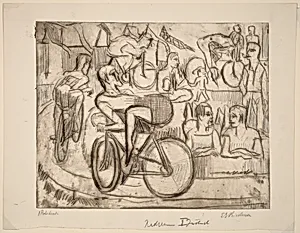
Medium
drypoint proof printed in brown-black ink and touched with graphite
Dimensions
image: 25 x 31.3 cm (9 13/16 x 12 5/16 in.) sheet: 30.3 x 38.8 cm (11 15/16 x 15 1/4 in.)
Classification
Department
CG-W
Museum
National Gallery of Art, Washington, D.C.
Credit
Gift of Ruth Cole Kainen
Accession Number
2012.92.728
Rights
Public Domain
Art Historical Context
Ernst Ludwig Kirchner's *Cycle Race* (1926) captures the frenetic energy of modern life through the lens of a German Expressionist master. As a founding member of the Die Brücke group, Kirchner was renowned for his raw, distorted forms and vivid depictions of urban dynamism, often reflecting the social upheavals of post-World War I Germany. By 1926, living in self-imposed exile in the Swiss Alps after a mental health crisis, Kirchner turned increasingly to printmaking, channeling his restless spirit into scenes of speed and motion—like this bicycle race—that evoke the thrill of the Weimar era's sporting culture. This drypoint proof, printed in rich brown-black ink and subtly enhanced with graphite touches, exemplifies Kirchner's mastery of intaglio techniques. Drypoint involves scratching directly into a metal plate, producing the burr that yields deeply textured, velvety lines ideal for conveying movement and immediacy. As a proof, this rare trial impression (image: 25 x 31.3 cm) offers an intimate glimpse into the artist's process, with the graphite additions providing personal flourishes not found in final editions. Housed in the National Gallery of Art as a gift from Ruth Cole Kainen, *Cycle Race* stands as a testament to Kirchner's enduring influence on modern printmaking, blending technical innovation with emotional intensity. Visitors will appreciate its tactile quality, a snapshot of 1920s vitality frozen in ink.
About the Artist
Ernst Ludwig Kirchner · 1880–1938
Ernst Ludwig Kirchner was born on May 6, 1880, in Aschaffenburg, Germany, to parents Ernst and Maria Kirchner, part of a family of Prussian descent that frequently relocated due to his father's career as a chemical technician. After early schooling in various towns, he studied architecture at the Königliche Technische Hochschule (Technical University) in Dresden from 1901 to 1905, taking courses i...