
Cylinder seal
Unknown Artist
ca. 14th century BCE
Medium
Hematite, gold
Dimensions
H. 3.2 cm x Diam .9cm seal x Diam. 1.4 cm terminal
Classification
Stone-Cylinder Seals-Inscribed
Culture & Period
Cypriot · Late Cypriot II
Department
Ancient Near Eastern Art
Museum
Metropolitan Museum of Art, New York, NY
Credit
Gift of Nanette B. Kelekian, in memory of Charles Dikran and Beatrice Kelekian, 1999
Accession Number
1999.325.218
Rights
Public Domain
Tags
Art Historical Context
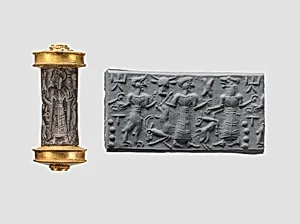
This exquisite cylinder seal, crafted in the Late Cypriot II period around the 14th century BCE, hails from ancient Cyprus—a vibrant hub of Mediterranean trade linking the Near East, Egypt, and the Aegean world. Cylinder seals like this one were ingenious tools of the Bronze Age: rolled across wet clay to leave a raised impression, they served as personal signatures for authenticating documents, goods, or property ownership. Belonging to the Ancient Near Eastern Art collection at the Metropolitan Museum of Art this inscribed example reflects Cyprus's cultural exchanges, adopting a Mesopotamian invention while infusing it with local flair. Carved from durable hematite—a dense, metallic stone prized for its hardness and ability to hold fine engravings—the seal measures just 3.2 cm high, with a 0.9 cm engraving diameter and a 1.4 cm terminal, possibly adorned with gold for added prestige. Its surface features human figures, likely deities or officials in dynamic scenes, showcasing the meticulous intaglio technique where motifs are incised deeply for crisp impressions. Hematite's sheen and the gold accent highlight the artisan's skill and the object's status symbol. In Cypriot society, such seals underscored administrative sophistication amid booming commerce in copper and luxury goods. Donated in 1999 in memory of Charles Dikran and Beatrice Kelekian, this artifact offers a tangible glimpse into a prosperous era, where art bridged empires and everyday authority.