
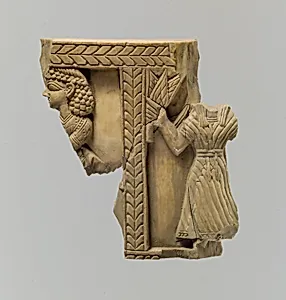
Cylindrical box fragment with female figures
Unknown Artist
ca. 8th century BCE
Medium
Ivory
Dimensions
2.6 x 2.24 x 0.51 in. (6.6 x 5.69 x 1.3 cm)
Classification
Ivory/Bone-Vessels
Culture & Period
Assyrian · Neo-Assyrian
Department
Ancient Near Eastern Art
Museum
Metropolitan Museum of Art, New York, NY
Credit
Rogers Fund, 1954
Accession Number
54.117.5
Rights
Public Domain
Tags
Art Historical Context
This delicate ivory fragment from a cylindrical box, dating to around the 8th century, offers a glimpse into the opulent world of the Neo-Assyrian Empire. Carved during the height of Assyrian power—when kings like Sargon II expanded their vast domain—this small piece (just 2.6 x 2.24 x 0.51 inches) adorned a luxury vessel for cosmetics, jewelry, or. The surface features graceful female figures, a common motif in Assyrian art symbolizing beauty, fertility, or divine attendants, evoking the refined tastes of palace elites. Ivory, a prized import from regions like India or Africa, was a status symbol in ancient Near Eastern courts. Artisans employed masterful low-relief carving techniques, incising intricate details into the hard material with fine tools to create fluid drapery and expressive poses. Such fragments, often discovered in royal palaces like Nimrud or Nineveh, highlight the Neo-Assyrians' technical prowess and cultural exchange along trade routes. Today, housed in the Metropolitan Museum of Art's Ancient Near Eastern Art department (acquired via the Rogers Fund in 1954), this artifact underscores the enduring allure of Assyrian craftsmanship. Though incomplete, it invites us to imagine the scented chambers of ancient Mesopotamia, where art blended daily luxury with imperial grandeur.