
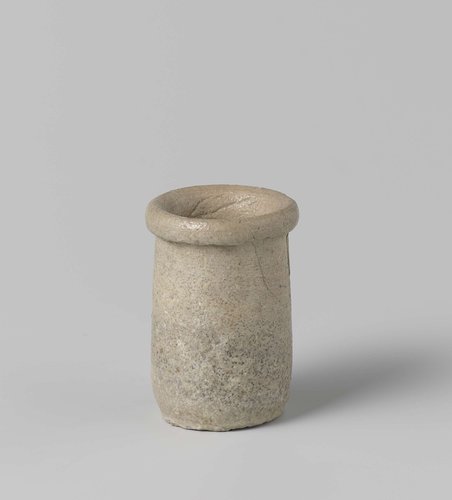
Cylindrical jar
c. 1600 - c. 1699
Medium
turning
Dimensions
3.5; 5.1; 2.8
Rights
Public Domain
About this artwork
steengoed
Art Historical Context
This delicate cylindrical jar, crafted anonymously around 1600–1699, exemplifies the everyday artistry of 17th-century ceramics. Standing just 5.1 cm high and 3.5 cm in diameter, its petite scale suggests it may have served practical purposes, such as holding spices, inks, or personal toiletries in a household setting. The simple, elegant form highlights the potter's skill in creating functional beauty from humble materials. Made of *steengoed*— for stoneware—this jar was produced using the "turning" technique, where clay is shaped on a potter's wheel. Stoneware's high-fired, non-porous body made it exceptionally durable and resistant to liquids, a significant advancement over earlier earthenwares. Popular in Northern Europe during the Dutch Golden Age, such vessels reflect the era's booming trade and craftsmanship, blending utility with subtle refinement. Though unsigned, this jar offers a window into anonymous makers whose work fueled daily life. Its survival speaks to stoneware's longevity, inviting us to appreciate the quiet mastery behind ordinary objects that shaped 17th-century culture.
About the Artist
anonymous
In the vast tapestry of art history, "Anonymous" stands not as a singular individual but as a collective designation for countless unidentified creators whose works have endured across millennia. These artists, spanning prehistoric cave painters to medieval illuminators and folk craftsmen, produced the foundational layers of human visual culture. Prior to the Renaissance, when individual fame emer...