
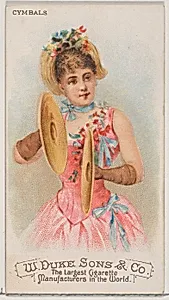
Cymbals, from the Musical Instruments series (N82) for Duke brand cigarettes
Medium
Commercial color lithograph
Dimensions
Sheet: 2 3/4 x 1 1/2 in. (7 x 3.8 cm)
Classification
Prints|Ephemera
Department
Drawings and Prints
Museum
Metropolitan Museum of Art, New York, NY
Credit
The Jefferson R. Burdick Collection, Gift of Jefferson R. Burdick
Accession Number
63.350.204.82.16
Rights
Public Domain
Tags
Art Historical Context
Step into the vibrant world of 19th-century American advertising with *Cymbals*, a tiny gem from the Musical Instruments series (N82 issued by W. Duke, Sons & Co. in 1888. Produced in collaboration with Schumacher & Ett, this commercial color lithograph measures just 2 3/4 x 1 1/2 inches, perfectly sized as an insert for Duke cigarette packs. These collectible cards captivated smokers and enthusiasts alike, turning everyday tobacco purchases into a hunt for educational and entertaining imagery of musical instruments like the gleaming cymbals featured here. Chromolithography, the medium's hallmark technique, allowed for bold, vivid colors and intricate details in mass production, making high-quality illustrations affordable and widespread. Part of a popular series blending art with commerce, it reflects the era's booming tobacco industry—led by innovators like the Duke family—and a cultural fascination with music, musicians, and women in performative roles, as hinted by the tags. Today, preserved in the Metropolitan Museum of Art's Jefferson R. Burdick Collection, this ephemera highlights how fleeting promotional prints became lasting artifacts of social history, bridging commerce, collecting, and the performing arts. A delightful snapshot of Gilded Age ingenuity!
About the Artist
W. Duke, Sons & Co.|Schumacher & Ettlinger · 1870–1920
**W. Duke, Sons & Co.: Pioneers of Chromolithographic Trade Card Art** W. Duke, Sons & Co., an American tobacco manufacturer, emerged from the entrepreneurial vision of Washington Duke (1820–1905) and his sons in Durham, North Carolina. After the Civil War, Washington abandoned farming in 1874 to join his eldest son, Brodie L. Duke, in the burgeoning tobacco trade, establishing a factory that for...