
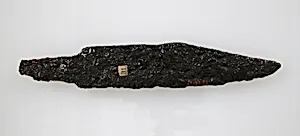
Dagger Blade
Unknown Artist
500–600
Medium
Iron
Dimensions
Overall: 6 1/8 x 1 x 3/8 in. (15.5 x 2.6 x 1 cm)
Classification
Metalwork-Iron
Culture
Frankish
Department
Medieval Art
Museum
Metropolitan Museum of Art, New York, NY
Credit
Gift of J. Pierpont Morgan, 1917
Accession Number
17.193.55
Rights
Public Domain
Art Historical Context
This slender iron dagger blade, forged by an unknown Frankish artisan around 500–600 CE, offers a glimpse into the martial world of the Merovingian Franks, the Germanic tribes who dominated much of early medieval Europe. Measuring just 6 1/8 x 1 x 3/8 inches (15.5 x 2.6 x 1 cm), its compact form suggests it was designed for close combat or as a sidearm, perfectly suited to the daily life of warriors in what is now France and Germany. Crafted from iron—a material prized for its strength and availability—this piece exemplifies early medieval metalworking techniques, likely involving hammering and quenching to achieve a durable edge. In the turbulent post-Roman era, such blades were more than tools of war; they symbolized status and prowess among Frankish elites, who expanded their kingdom under kings like Clovis I. Frankish ironwork like this reflects a blend of Roman influences and Germanic innovation, transitioning from late antiquity into the Middle Ages. Donated to the Metropolitan Museum of Art in 1917 by J. Pierpont Morgan, it now resides in the Medieval Art department, reminding us of the craftsmanship that armed a pivotal era in European history. Though simple in design, this dagger blade whispers stories of conquest, survival, and skilled hands shaping iron into legacy.