
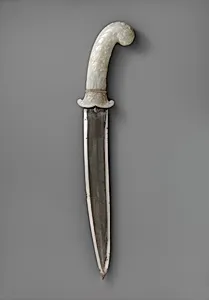
Dagger with Hilt of Leafy Plants
Unknown Artist
ca. 1640
Medium
Hilt: Nephrite Blade: Watered steel
Dimensions
Max length with handle: 14 3/8 in. (36.5 cm) Length of the Handle: 4 13/16 in. (12.2 cm) Length of the Blade: 9 11/16 in. (24.6 cm) Width of bottom of the handle: 2 in. (5.1 cm)
Classification
Arms and Armor
Department
Islamic Art
Museum
Metropolitan Museum of Art, New York, NY
Credit
Purchase, Mr. and Mrs. Nathaniel Spear Jr. Gift, 1982
Accession Number
1982.321
Rights
Public Domain
Tags
Art Historical Context
This elegant dagger, created around 1640 and now part of the Metropolitan Museum of Art’s Islamic Art collection, exemplifies the refined artistry of arms and armor in the Islamic world. Its hilt, carved from nephrite—a smooth, durable form of jade—features delicate leafy plant motifs that evoke the lush gardens celebrated in Persian and Mughal traditions. The blade, forged from watered steel, displays the distinctive rippling patterns prized for both strength and visual beauty, transforming a functional weapon into a luxurious object. Such daggers served not only as practical tools but also as symbols of status and craftsmanship. The intricate carving of the nephrite hilt highlights the skill of unknown artisans who blended natural forms with geometric precision, a hallmark of Islamic decorative arts. Acquired by the museum in 1982 through a generous gift, this piece invites visitors to appreciate how everyday items were elevated through exquisite materials and thoughtful design. Measuring just over 14 inches in total length, the dagger’s compact form made it both portable and ornate, reflecting the cultural importance of finely wrought arms during the 17th century. Its leafy decoration and contrasting steel blade demonstrate a harmonious balance between utility and aesthetic elegance.