
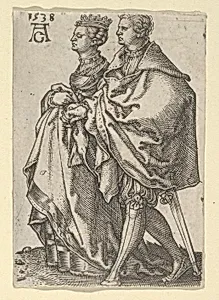
Dancing Couple Stepping to the Left, from "The Small Wedding Dancers"
Medium
Engraving
Dimensions
Sheet: 2 1/16 × 1 1/2 in. (5.3 × 3.8 cm)
Classification
Prints
Department
Drawings and Prints
Museum
Metropolitan Museum of Art, New York, NY
Credit
The Elisha Whittelsey Collection, The Elisha Whittelsey Fund, 1966
Accession Number
66.529.61
Rights
Public Domain
Tags
Art Historical Context
Heinrich Aldegrever's *Dancing Couple Stepping the Left* (1538) captures a lively moment from his series "The Small Wedding Dancers a delightful set of engravings depicting festive wedding celebrations in 16th-century Germany. As one of the "Little Masters"—a group of Northern Renaissance printmakers renowned for their miniature, intricate works—Aldegrever brings to life the joyous energy of rural courtship rituals. Created during the Reformation era in Westphalia, where he worked as both engraver and goldsmith, this piece reflects the era's growing fascination with everyday social scenes, blending piety with secular merriment. Measuring just over 2 inches tall, this engraving showcases Aldegrever's masterful technique: fine, precise lines etched into copper plates to produce affordable, reproducible art for middle-class homes. The couple's dynamic pose—mid-step in a folk dance—highlights rhythmic movement and intimate connection, with clothing and gestures evoking authentic peasant attire. Such prints democratized art, spreading Renaissance humanism beyond elite patrons. Part of The Metropolitan Museum of Art's Elisha Whittelsey Collection, this tiny gem invites visitors to marvel at how Aldegrever packed vivid storytelling into pocket-sized precision, offering a window into the human heart of Renaissance revelry.
About the Artist
Heinrich Aldegrever · 1502–1561
Heinrich Aldegrever, born in 1502 in Paderborn, Westphalia, to parents Herman and Katherine Trippenmeker—a family of clog-makers known by the dialect name Trippenmecker—emerged as a multifaceted artist in the German Renaissance. His early training remains undocumented, though he likely apprenticed in a Soest goldsmith's workshop after relocating there around 1525, where he joined the painters' gui...