
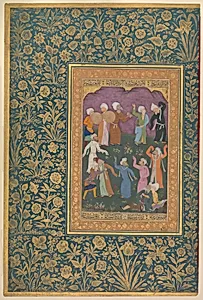
"Dancing Dervishes", Folio from the Shah Jahan Album
recto: ca. 1610; verso: ca. 1530–50
Medium
Ink, opaque watercolor, and gold on paper
Dimensions
H. 15 3/16 in. (38.6 cm) W. 10 3/16 in. (25.9 cm)
Classification
Codices
Department
Islamic Art
Museum
Metropolitan Museum of Art, New York, NY
Credit
Purchase, Rogers Fund and The Kevorkian Foundation Gift, 1955
Accession Number
55.121.10.18
Rights
Public Domain
Tags
Art Historical Context
Behold the enchanting "Dancing Dervishes," a-sided folio from the illustrious Shah Jahan Album, by the masterful Mir 'Ali Haravi. The recto, dated around 1610, and verso from circa 1530–50, showcase ink, opaque watercolor, gold on paper, measuring 15 3/16 x 10 3/16 inches. Housed in the Metropolitan Museum of Art's Islamic Department, this codex leaf captures swirling figures amid musical instruments, ev the rhythmic ecstasy of Sufi dervishes in motion. Mir 'Ali Haravi, a luminary from Herat's renowned school of Persian miniature painting, exemplifies the Safavid-era finesse later prized in Mughal courts. Compiled during Emperor Shah Jahan's reign (1628–1658)—famed for the Taj Mahal—this album gathered treasures from across the Islamic world, blending Timurid, Safavid, and Mughal aesthetics. The dervishes' whirling dance symbolizes spiritual devotion, a core Sufi ritual blending music, poetry, and trance-like rotation to connect with the divine. The artwork's luminous gold accents and vivid pigments highlight virtuoso techniques in Persianate illumination, preserving cultural snapshots of joyous devotion. A testament to cross-cultural exchange, it invites visitors to ponder the timeless harmony of art, faith, and festivity in Islamic heritage.