
Das leere Café (The Empty Café)
1918
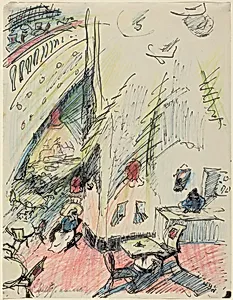
Medium
pen and black ink with crayons on wove paper
Dimensions
overall: 33.9 x 26.2 cm (13 3/8 x 10 5/16 in.)
Classification
Drawing
Department
CG-W
Museum
National Gallery of Art, Washington, D.C.
Credit
Merritt Porter Dyke Fund
Accession Number
2007.71.2
Rights
Public Domain
Art Historical Context
**Das leere Café (The Empty Café)**, created by German artist Walter Gramatté 1918, captures haunting sense of solitude in a mixed-media drawing on wove paper. Measuring just 33.9 x 26.2 cm, this intimate work employs pen and black ink for sharp, expressive lines, enhanced by crayons that add depth and subtle tonal variations. The smooth wove paper provides an ideal surface for Gramatté's precise yet emotive technique, allowing for intricate details that evoke atmosphere without color. Completed at the close of World War I, the artwork reflects the era's pervasive melancholy and disruption. Gramatté, an early Expressionist influenced by the turbulent artistic scene in Berlin, often explored themes of isolation and the uncanny through angular forms and stark compositions. The empty café—devoid of patrons—serves as a poignant symbol of absence, perhaps mirroring the social desolation following the war's devastation. Housed in the National Gallery of Art through the Merritt Porter Dyke Fund, this drawing exemplifies Gramatté's mastery of graphic media. His innovative blend of ink and crayon not only demonstrates technical virtuosity but also underscores the emotional intensity of Expressionism, inviting viewers to ponder the quiet voids left in everyday spaces. A gem for those fascinated by early 20th-century introspection.
About the Artist
Walter Gramatté · 1897–1929
Walter Gramatté, born Walter Eduard Gramatté on January 8, 1897, in Berlin-Wedding to building manager Otto Gramatté and his wife Katharina, emerged as a poignant voice in German Expressionism despite a tragically brief career. The son of modest parents—described variably as a baker in some accounts—Gramatté volunteered for World War I in 1914 but was largely spared frontline duty due to chronic p...