
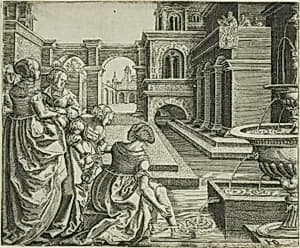
David and Bathsheba
c. 1545
Medium
Engraving in black on ivory laid paper
Dimensions
Image/plate/sheet: 7.9 × 9.6 cm (3 1/8 × 3 13/16 in.)
Classification
engraving
Department
Prints and Drawings
Museum
Art Institute of Chicago
Accession Number
77477
Rights
Public Domain
Art Historical Context
In the Prints and Drawings department of the Institute of Chicago sits a delicate engraving titled *David and Bathshe*, created around 1545 by the German artist Hans Brosamer. This small-scale work (just 7.9 × 9.6 cm) captures a pivotal biblical scene from 2 Samuel 11, where King David gazes upon the bathing Bathsheba, igniting a tale of desire, power, and moral reckoning. Brosamer, a Frankfurt-based engraver active during the Northern Renaissance, drew inspiration from masters like Albrecht Dürer infusing his prints with intricate detail and emotional depth to make sacred stories accessible to a wide audience. Rendered in black ink on rare ivory laid paper, the engraving showcases Brosamer's mastery of the intaglio technique: fine lines incised into a metal plate create subtle tones and textures, from the soft folds of Bathsheba's skin to the architectural backdrop. This medium was revolutionary in the 16th century, allowing affordable reproduction of complex imagery amid the Protestant Reformation's push for personal Bible study. Its intimate size suggests it was designed for private devotion or collectors, bridging elite art with everyday piety. Brosamer's work exemplifies how engravings democratized Renaissance artistry, blending humanism with religious narrative. Visitors will appreciate its technical precision—a testament to an era when prints rivaled paintings in storytelling power.