
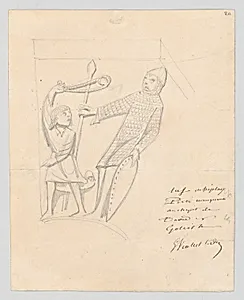
David and Goliath, after a Capital in Vézelay Abbey
ca. 1840
Medium
Graphite
Dimensions
Sheet: 7 1/8 × 5 13/16 in. (18.1 × 14.7 cm)
Classification
Drawings
Department
Drawings and Prints
Museum
Metropolitan Museum of Art, New York, NY
Credit
Gift of Asher Ethan Miller, in honor of Eric G. Carlson, 2016
Accession Number
2016.105
Rights
Public Domain
Tags
Art Historical Context
In the hallowed halls of Vézelay Abbey a Romanesque masterpiece in Burgundy, France, intricately carved capitals depict vivid biblical scenes, including the triumph of David over Goliath. This delicate graphite drawing by Eugènemanuel Viollet-le-D, created around 1840, faithfully captures one such capital. As a pioneering architect and restorer of medieval monuments, Viollet-le-Duc meticulously documented these sculptures during his surveys, preserving their details for posterity amid 19th-century restoration effortsRendered on a modest 7 1/8 × 5 13/16 in. sheet, the work showcases Viollet-le-Duc's precise graphite technique, which renders the stone's textures, dynamic poses of the soldier-like Goliath and youthful David wielding his sling and sword, and intricate weaponry with remarkable clarity. Belonging to the Gothic Revival movement, his drawings bridged medieval artistry with modern scholarship, influencing how we understand Romanesque sculpture's narrative power and symbolic depth—the underdog's victory as a tale of faith and ingenuity. Today, housed in The Metropolitan Museum of Art's Drawings and Prints department (gift of Asher Ethan Miller, 2016), this study invites visitors to marvel at how a simple sketch revives an ancient story, connecting us to the pilgrims who once gazed upon the original capital.