
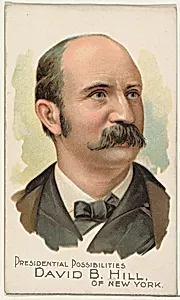
David B. Hill of New York, from the Presidential Possibilities series (N124) issued by Duke Sons & Co. to promote Honest Long Cut Tobacco
Medium
Commercial color lithograph
Dimensions
Sheet: 4 1/8 × 2 1/2 in. (10.4 × 6.4 cm)
Classification
Prints|Ephemera
Department
Drawings and Prints
Museum
Metropolitan Museum of Art, New York, NY
Credit
The Jefferson R. Burdick Collection, Gift of Jefferson R. Burdick
Accession Number
63.350.206.124.13
Rights
Public Domain
Tags
Art Historical Context
Step into the vibrant world of 19th-century American advertising with this charming commercial color lithograph from 1888, featuring David B. Hill of New. Produced by W. Duke, Sons & Co. in collaboration with The Giles Company it's part of the "Presidentialibilities" series (N124), a set of collectible cards issued to promote "Honest Cut Tobacco." Measuring just 4 1/8 × 2 1/2 inches, these pocket-sized portraits captured the imagination of tobacco enthusiasts, speculating on potential U.S. presidential candidates during the heated 1888 election season between Benjamin Harrison and Grover Cleveland. David B. Hill, a prominent New York politician and governor, is depicted in a formal portrait style, embodying the era's fascination with political ambition. Chromolithography, the printing technique used here, allowed for vivid colors and mass production, transforming everyday ephemera into affordable art. These cards were wildly popular trade inserts, blending patriotism, celebrity, and commerce to boost sales. Today, housed in the Metropolitan Museum of Art's Jefferson R. Burdick Collection, this piece highlights the cultural role of tobacco cards in American print culture. They offer a snapshot of Gilded Age politics and advertising ingenuity, reminding us how even small prints could influence public discourse and collecting passions.
About the Artist
W. Duke, Sons & Co.|The Giles Company · 1870–1920
**W. Duke, Sons & Co.: Pioneers of Chromolithographic Trade Card Art** W. Duke, Sons & Co., an American tobacco manufacturer, emerged from the entrepreneurial vision of Washington Duke (1820–1905) and his sons in Durham, North Carolina. After the Civil War, Washington abandoned farming in 1874 to join his eldest son, Brodie L. Duke, in the burgeoning tobacco trade, establishing a factory that for...