
De Bataafse Opstand
1612
Medium
etching
Dimensions
210; 167
Rights
Public Domain
About this artwork
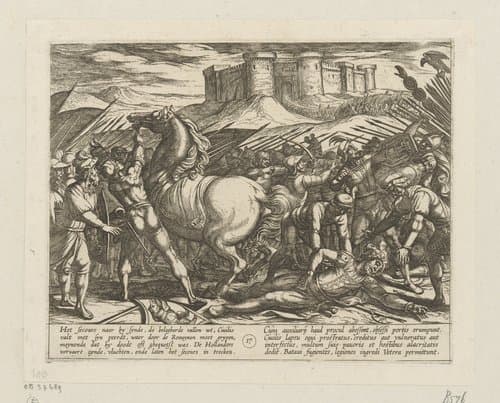
Civilis valt van zijn paard om de Romeinen te misleiden en te laten denken dat hij dood of gewond is. Prent nummer 17 in de serie prenten over de Bataafse Opstand: Batavorum cum Romanis bellum / à Corn. Tacito lib. IV & V. : Hist. olim descriptum, figuris nunc aeneis expressum, auctore Othone Vaenio Lugdunobatava = De Batavische oft oude Hollandtsche oorloghe teghen de Romeynen. Otto Vaenius, Antwerpen 1612. Onderaan twee verzen van vier regels in het Nederlands en in het Latijn. Zonder tekst op...
Art Historical Context
**De Bataafse OpstandThe Batavian Revolt)** *Antonio Tempesta, 1612, etching, approx. 167 × 210 mm* This dynamic etching by Italian artist Antonio Tempesta captures pivotal moment from the ancient Batavian Revolt: the Batavian leader Julius Civilis falling from his horse to trick the Romans into believing him dead or wounded. As print number 17 in Otto Vaenius's renowned series *Batavorum cum Roman bellum*, published in Antwerp, it vividly illustrates Books IV and V of Tacitus's *Histories*. The bilingual verses below—four lines each in Dutch and Latin—add a poetic layer, emphasizing themes of cunning resistance against imperial might. Drawn from Tacitus's first-century account of the 69–70 AD uprising by the Batavian tribe against Roman rule in the Low Countries, the series resonated deeply in 1612's Dutch Republic. Amid their own struggle for independence from Spain, Dutch audiences saw Civilis as a heroic ancestor, fueling national pride during the Eighty Years' War. Vaenius, a Flemish master and Rubens's teacher, commissioned these copperplate engravings to blend classical history with contemporary patriotism. Tempesta's etching technique—biting acid into metal plates for intricate lines—brings chaotic energy to the battle, with rearing horses and clashing warriors. Compact yet intense, this print exemplifies early 17th-century graphic artistry, making ancient drama accessible and inspiring for viewers then and now.
About the Artist
Antonio Tempesta · 1555–1630
Antonio Tempesta (1555–1630), known as 'Il Tempestino,' was a Florentine painter and printmaker whose extraordinary output of approximately 1,700 etchings made him one of the most influential printmakers of the early Baroque period. Born in Florence and trained under Santi di Tito and the Flemish master Joannes Stradanus, he enrolled in the Accademia del Disegno in 1576 before relocating to Rome i...