
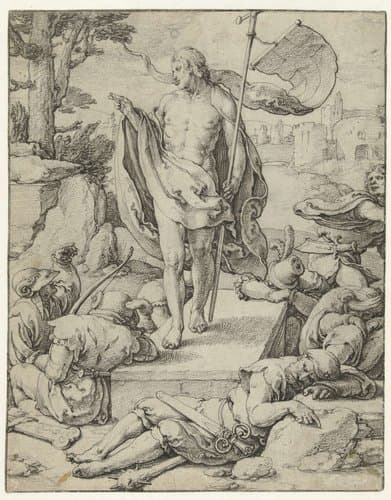
De opstanding
in or after 1529 - 1533
Medium
brush
Dimensions
252; 199
Rights
Public Domain
About this artwork
signatuur en datum: ‘L 1525(?)’
Art Historical Context
**De Opstanding (The Resurrection)** by Lucas van Leyden stands as a poignant example of Northern Renaissance draftsmanship. Created in or after 1529 possibly dated 1525 (as indicated by the monogrammed signature 'L 152(?)'), this intimate brush drawing measures just 252 mm high by 199 mm wide. Van Leyden, a prodigious Dutch artist (1494–1533) often called the "Dutch Dürer," masterfully depicts the biblical moment of Christ's resurrection, a theme central to Christian iconography during the Reformation era. Lucas van Leyden bridged late Gothic traditions with emerging Renaissance naturalism, excelling in engravings, paintings, and preparatory drawings like this one. His fluid brushwork—likely in ink or wash—captures dynamic movement and emotional intensity in a compact format, ideal for studies or private devotion. This late-period piece reflects his mature style, influenced by travels to Antwerp and encounters with Italianate forms, yet rooted in meticulous Northern detail. Its small scale and technique highlight van Leyden's innovative use of brush as a versatile medium, blending spontaneity with precision. As one of his final works before his early death, *De Opstanding* offers visitors a window into 16th-century artistic innovation amid religious upheaval, inviting contemplation of life's eternal themes.
About the Artist
Lucas van Leyden · 1484–1533
Lucas van Leyden (1494–1533) was a Dutch painter and printmaker who stands among the greatest engravers of the Northern Renaissance. Born in Leiden as either Lucas Hugensz or Lucas Jacobsz, he lived and worked primarily in his native city, achieving international renown that rivaled the German master Albrecht Dürer. Lucas van Leyden revolutionized Netherlandish printmaking and was among the first...