
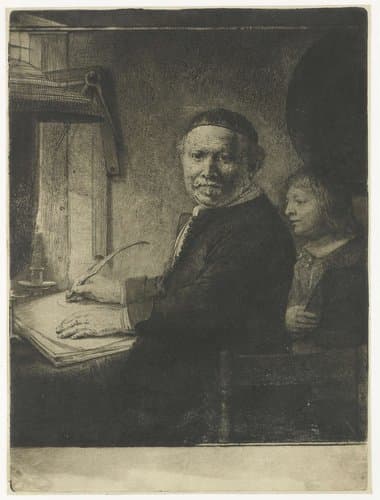
De schrijfmeester Lieven Willemsz. van Coppenol: kleine plaat
ca. 1658
Medium
etching
Dimensions
191; 257
Rights
Public Domain
About this artwork
ets, droge naald en burijn, met plaattoon op Oosters papier
Art Historical Context
Rembrandt van Rijn'sDe schrijfmeesterven Willemsz. Coppenol: kleine* (ca. 1658) is a masterful etching capturing the likeness of Lieven Willemsz. Coppenol, a Dutch writing master and calligrapher during the Dutch Golden Age. This smaller plate version, measuring 257 × 191 mm, showcases's skill in portraiture, portraying Coppenol with intense focus amid scattered papers and ink tools—symbols of his scholarly profession. Rembrandt created two etched portraits of Coppenol, reflecting his fascination with character studies and the era's admiration for mastery in writing and penmanship. Printed on prized Eastern paper, the work employs a sophisticated blend of techniques: etching for fine lines, drypoint for rich, velvety burr, burin for precise engraving, and subtle plate tone to evoke depth and atmosphere. These methods allowed Rembrandt, a Baroque innovator, to achieve painterly effects rivaling his oil paintings, pushing printmaking toward expressive artistry rather than mere reproduction. As one of Rembrandt's late masterpieces, this etching highlights his experimental genius, with impressions varying across states due to his iterative refinements. It invites visitors to appreciate how 17th-century Dutch art celebrated intellectual pursuits, blending technical virtuosity with human insight.
About the Artist
Rembrandt van Rijn · 1606–1669
Rembrandt Harmenszoon van Rijn (1606–1669) stands as one of the greatest visual artists in the history of Western art and the most important Dutch painter of the 17th century. Born in Leiden to a prosperous miller's family, Rembrandt transformed painting through his revolutionary use of light and shadow, his psychological depth in portraiture, and his elevation of etching to a fine art. His approx...