
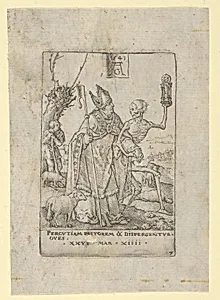
Death and the Bishop, from "The Power of Death" (Allegory of Original Sin and Death)
Medium
Engraving
Dimensions
Sheet: 4 3/16 × 2 15/16 in. (10.7 × 7.5 cm) Plate: 2 5/8 × 1 15/16 in. (6.6 × 5 cm)
Classification
Prints
Department
Drawings and Prints
Museum
Metropolitan Museum of Art, New York, NY
Credit
Bequest of Grace M. Pugh, 1985
Accession Number
1986.1180.6
Rights
Public Domain
Tags
Art Historical Context
In the chilling engraving *Death and the Bishop* from Heinrich Aldegre's series *The Power of Death (also known as an Allegory of Original Sin Death), created in 1541, a skeletal figure of Death confronts a bishop amid symbolic elements like sheep, evoking the flock under a shepherd's care. This print—measuring just 2 5/8 × 1 15/16 inches on the plate—exemplifies the meticulous detail of Northern Renaissance engraving, a technique Aldegrever mastered as one of the "Little Masters renowned for intricate small-scale works that could be widely distributed and pondered. Produced during the Protestant Reformation, the image serves as a *memento mori*, a stark reminder of mortality's universality, even for the powerful clergy. Death's inexorable grip critiques ecclesiastical corruption or underscores original sin's consequences, with sheep perhaps alluding to the bishop's spiritual charges led astray. Attributed variably to Aldegrever or Hans Holbein the Younger, it reflects the era's moral allegories, blending Gothic morbidity with Renaissance precision. Today, housed in the Metropolitan Museum of Art's Drawings and Prints department (Bequest of Grace M. Pugh, 1985), this engraving invites visitors to reflect on life's fragility, much like it did for 16th-century viewers handling affordable prints as personal meditations.
About the Artist
Heinrich Aldegrever|Hans Holbein the Younger · 1502–1561
Heinrich Aldegrever, born in 1502 in Paderborn, Westphalia, to parents Herman and Katherine Trippenmeker—a family of clog-makers known by the dialect name Trippenmecker—emerged as a multifaceted artist in the German Renaissance. His early training remains undocumented, though he likely apprenticed in a Soest goldsmith's workshop after relocating there around 1525, where he joined the painters' gui...