
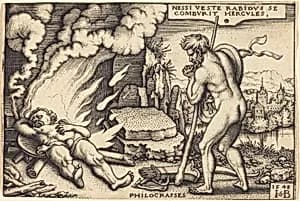
Death of Hercules
1548
Medium
engraving
Classification
Department
CG-E
Museum
National Gallery of Art, Washington, D.C.
Credit
Rosenwald Collection
Accession Number
1943.3.9332
Rights
Public Domain
Art Historical Context
Step into the intense mythological drama of *Death of Hercules* (1548), a masterful engraving by Sebald Beham, one the renowned "Little Masters" of the German Renaissance. Beham, a Nuremberg artist influenced by Albrecht Dürer captures the tragic final moments of the hero Hercules, poisoned by the centaur Nessus's blood-soaked tunic gifted unwittingly by his wife Deian. Seated on his pyre amid swirling flames and anguished figures, Hercules embodies stoic suffering, a popular subject in Renaissance art symbolizing heroic endurance and mortality. This small-scale print exemplifies the engraving medium's power: Beham's precise burin work creates intricate cross-hatching and fine lines, achieving remarkable depth, texture, and emotional tension on a modest copper plate. As an affordable alternative to paintings, such engravings democratized art, spreading classical myths across Europe during the 16th century's humanist revival. Housed in the National Gallery of Art's Rosenwald Collection, this work highlights Beham's legacy in the vibrant print culture of Reformation-era Nuremberg, where technical innovation met profound storytelling. A testament to the era's fascination with antiquity, it invites us to ponder the fleeting nature of even the mightiest lives.
About the Artist
Sebald Beham · 1500–1550
Sebald Beham (1500–1550), a pioneering German printmaker and painter born in Nuremberg, emerged as one of the most prolific artists of the Northern Renaissance. The elder brother of fellow artist Barthel Beham, he grew up in a milieu steeped in artistic tradition, though details of his early training remain sparsely documented. Recorded as a journeyman painter (Malergeselle) by 1521 and a master w...