
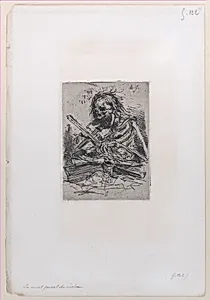
Death Playing the Violin
1846
Medium
Etching
Dimensions
Sheet: 11 1/4 × 7 11/16 in. (28.5 × 19.5 cm) Plate: 4 3/4 × 3 9/16 in. (12 × 9 cm)
Classification
Prints
Department
Drawings and Prints
Museum
Metropolitan Museum of Art, New York, NY
Credit
Rogers Fund, 1922
Accession Number
22.63.56
Rights
Public Domain
Tags
Art Historical Context
In the mid-19th century, artist Charles Jacque, a member of the Barbizon known for his rustic landscapes and animal studies, ventured into the macabre with *Death Playing the Violin (1846). This intimate etching captures a skeletal figure of Death animatedly playing a violin, evoking longstanding European tradition of the *Danse Macabre*—a reminder of mortality's universal dance. Created during the Romantic era's fascination with the gothic and ephemeral nature of life, the work blends Jacque's precise draftsmanship with allegorical symbolism, using the violin as a metaphor for life's fleeting melody. Etching, Jacque's chosen medium, allowed for intricate line work on a small copper plate (just 4 3/4 × 3 9/16 in.), producing rich, tonal contrasts when inked and printed. The technique's durability enabled multiple impressions, making such prints accessible to a wider audience beyond oil paintings. This piece, acquired through the Rogers Fund in 1922, exemplifies 19th-century printmaking's role in disseminating provocative ideas. Today, at the Metropolitan Museum of Art's Drawings and Prints department, *Death Playing the Violin* invites visitors to ponder mortality with a wry, musical twist—perfect for those drawn to skeletons and strings in art's darker corners.
About the Artist
Charles Jacque · 1813–1894
Charles-Émile Jacque (1813–1894) was a pioneering French painter, engraver, and illustrator whose career bridged the worlds of printmaking and pastoral painting. Born in Paris amid a difficult childhood, he apprenticed at age seventeen to a map engraver, mastering drypoint technique and producing his first etching in 1830—a copy of a head after Rembrandt. After serving seven years in the French Ar...