
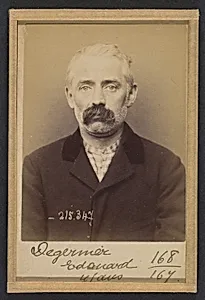
Dejernier (ou Degernier). Edouard. 45 ans, né à Gand (Belgique). Tailleur d'habits. Anarchiste. 8/3/94.
Medium
Albumen silver print from glass negative
Dimensions
10.5 x 7 x 0.5 cm (4 1/8 x 2 3/4 x 3/16 in.) each
Classification
Photographs
Department
Photographs
Museum
Metropolitan Museum of Art, New York, NY
Credit
Gilman Collection, Museum Purchase, 2005
Accession Number
2005.100.375.142
Rights
Public Domain
Tags
Art Historical Context
In the late 19th century, forensic pioneer Alphonse Bertillon criminal identification with his anthropometric system, known as *bertillonage*. This 1894 albumen silver print from a glass negative captures Edouard Dejernieror Degernier), a 45-year-old tailor in Ghent, Belgium, labeled simply as an "anarchiste." Measuring just 10.5 x 7 cm, the small portrait—part of a standard mugshot series with full-face and profile views—documents Dejernier's arrest on March 8, 1894, amid France's wave of anarchist bombings and political unrest. Bertillon's methodical approach emphasized precise measurements and standardized photography, producing stark, clinical images that prioritized documentation over artistry. Yet these works transcend mere police records, offering a poignant glimpse into the era's social tensions: anarchism, fueled by industrial hardships, challenged the status quo, casting ordinary workers like Dejernier as threats to order. Today, housed in the Metropolitan Museum of Art's Gilman Collection, this photograph highlights the intersection of photography's technical evolution—albumen prints yielded exceptional detail from glass negatives—and cultural history. It humanizes the "criminal other," inviting us to reflect on justice, identity, and the gaze of authority.
About the Artist
Alphonse Bertillon · 1853–1914
Alphonse Bertillon (1853–1914) was a pioneering French photographer whose work revolutionized forensic documentation, transforming police identification into a precise visual science. Born in Paris on April 22, 1853, he was the son of medical professor and statistician Louis-Adolphe Bertillon and the younger brother of demographer Jacques Bertillon. Lacking formal higher education after expulsion ...