
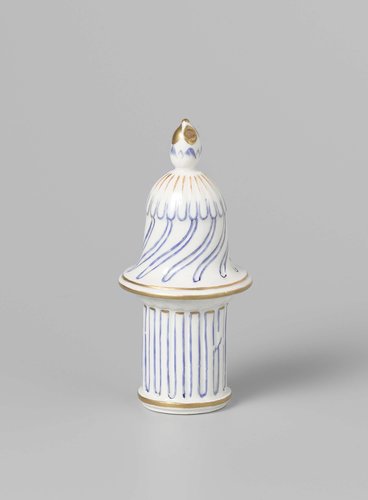
Deksel, onderdeel van een kandelaar-vaas
ca. 1778 - ca. 1782
Medium
porcelain
Dimensions
4.9; 10.8
Rights
Public Domain
About this artwork
Deksel van porselein, versierd met een lauwerkrans in reliëf. De gedraaide godrons op het deksel en de cannelures van de kaarsenhouder zijn omrand in blauw. Gouden biezen langs de randen. De knop van het deksel is versierd in blauw en goud; daaronder een stralenkrans in goud (grotendeels afgesleten, waardoor de roodbruine onderschildering zichtbaar is).
Art Historical Context
This delicate porcelain lid, crafted by the renowned Manufacture Oud-Loosdrecht around 1778–1782, forms part of an elegant candlestick-vase Standing just 10.8 cm high and 4.9 cm in diameter, it exemplifies the factory's mastery of soft-paste porcelain a material prized for its fine translucency and suitability for intricate molding. Founded in 1774 by Pieter Stas near Amsterdam, Oud-Loosdrecht was the Netherlands' premier porcelain producer, rivaling European giants like Meissen and Sèvres by blending functionality with opulent decoration for affluent households. The lid's surface features a raised laurel wreath in relief—a neoclassical motif symbolizing victory and classical antiquity—framed by twisted godrons (ribbed moldings) and subtle blue borders. Gold banding accents the edges, while the finial knob gleams in blue and gold over a radiant sunburst wreath, now partially worn to reveal the factory's characteristic reddish-brown underglaze. These techniques highlight the manufactory's innovative use of polychrome enamels and gilding, fired multiple times for durability and luster. As a survivor of daily use, this piece reflects the late 18th-century Dutch taste for versatile luxury items, bridging Rococo exuberance and emerging neoclassicism. Its preserved details offer a window into the skilled craftsmanship that made Oud-Loosdrecht porcelain a coveted export across Europe.