
Den Roomschen Uylen-spiegel. Getrokken uit verscheiden oude Roomsch Catholyke Legendeboeken, ende andere schryvers
1716
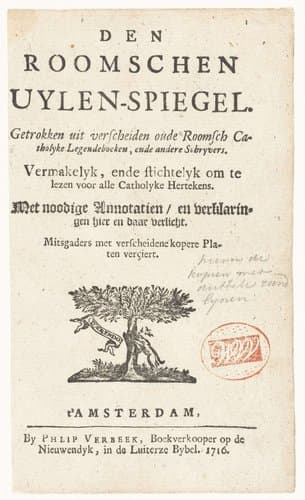
Medium
letterpress printing
Dimensions
157; 93
Rights
Public Domain
About this artwork
boekdruk en houtsnede
Art Historical Context
Step into the world of 18th-century Dutch religious satire with *Den Roomschen Uylen-spiegel* ("The Roman Owl Mirror"), a compact anonymous pamphlet published in 1716. Measuring just 157mm by 93mm, this pocket-sized work draws from old Catholic legend books to critique Roman Catholic traditions, using the owl—a symbol of folly and superstition—as a metaphor to "mirror" perceived absurdities in saints' tales and doctrines. Produced amid the Protestant Netherlands' enduring Reformation fervor, it reflects the era's sharp sectarian divides, where print became a weapon in theological debates. Crafted via letterpress printing (*boekdruk*) combined with woodcuts (*houtsnede*), the piece exemplifies accessible graphic propaganda. Letterpress allowed for precise text reproduction, while woodcuts provided stark, bold illustrations ideal for inexpensive dissemination among the literate public. These techniques democratized dissent, turning complex critiques into visually punchy pamphlets that could be widely shared. As a cultural artifact, *Den Roomschen Uylen-spiegel* highlights the power of early modern print in shaping public opinion, bridging art, literature, and polemic. Though anonymous, its survival underscores the vibrancy of Dutch intellectual life, inviting us to ponder how images and words once fueled Europe's religious identity.
About the Artist
anonymous
In the vast tapestry of art history, "Anonymous" stands not as a singular individual but as a collective designation for countless unidentified creators whose works have endured across millennia. These artists, spanning prehistoric cave painters to medieval illuminators and folk craftsmen, produced the foundational layers of human visual culture. Prior to the Renaissance, when individual fame emer...