
Denarius (Coin) Portraying Emperor Trajan
98-117
Medium
Silver
Dimensions
Diam.: 2 cm (13/16 in.)
Classification
coin
Department
Arts of Greece, Rome, and Byzantium
Museum
Art Institute of Chicago
Accession Number
141831
Rights
Public Domain
About this artwork
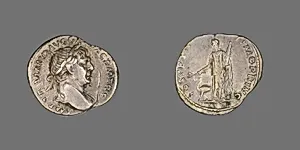
The front (obverse) of this coin portrays the head of Emperor Trajan, facing to the right. The back (reverse) depicts the personification of Arabia, standing facing left and holding a branch and a bundle of cinnamon sticks. At her feet stands a camel.
Art Historical Context
This gleaming silver denarius, minted during the reign of Emperorjan (r. 98–117 CE), offers a intimate glimpse into the heart of the Roman Empire at its zenith. Trajan, one of Rome's "Five Good Emperors," is celebrated for his military conquests—expanding the empire to its greatest extent—and grand public works, like the still-standing Trajan's Column in Rome. Struck in silver, the denarius was the empire's workhorse currency, used for everything from soldiers' pay to daily commerce, making the emperor's portrait a powerful tool of propaganda that reached every corner of the realm. Crafted with remarkable precision for its tiny 2 cm diameter, the coin showcases the artistry of Roman die-engraving techniques. The obverse likely bears Trajan's idealized profile—bearded and laurel-wreathed—symbolizing divine authority and military prowess, while the reverse might feature deities, victories, or imperial symbols to commemorate achievements. As part of the Art Institute of Chicago's Arts of Greece, Rome, and Byzantium collection, this coin exemplifies how everyday money doubled as monumental art, blending functionality with imperial ideology. Hold it up to the light, and you'll sense the pulse of ancient Rome: a tiny testament to Trajan's legacy of stability and splendor.
About the Artist
Ancient Roman
The artists attributed to "Ancient Roman" in museum collections represent the anonymous craftsmen who produced the vast output of sculpture, frescoes, mosaics, and reliefs defining Roman visual culture from the Republic (c. 509–27 BCE) to the late Empire (c. 395 CE). Individual identities remain elusive, as Roman makers were typically viewed as skilled tradesmen—often enslaved Greeks or provincial...