
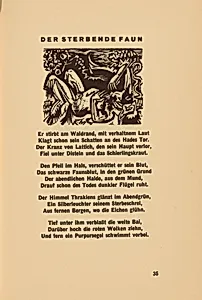
Der Sterbende Faun (The Dying Faun) (headpiece, page 35) from Georg Heym: Umbra Vitae (Georg Heym: The Shadow of Life)
Medium
woodcut from a bound volume with 50 woodcuts (including cover and front and back endpapers) on wove paper
Dimensions
book: 23.8 × 16.5 × 1.2 cm (9 3/8 × 6 1/2 × 1/2 in.)
Classification
Volume
Department
CG-W
Museum
National Gallery of Art, Washington, D.C.
Credit
Gift of Ruth Cole Kainen
Accession Number
2012.92.41.28
Rights
Public Domain
Art Historical Context
Ernst Ludwig Kirchner, a pioneering German Expressionist and co-founder of the Dieücke group, created *Der Sterbende Faun* (The Dying Faun in 1924 as a woodcut headpiece for page 35 of *Umbra Vitae* (Shadow of Life), a bound volume illustrating the dark, visionary poetry of Georg Heym. Produced during the turbulent Weimar Republic era, following Kirchner's own struggles with illness and postwar disillusionment, this work captures the shadowy themes of mortality and primal decay evoked by Heym's apocalyptic verses. The faun—a mythical half-man, half-goat figure—symbolizes fading vitality, rendered with Kirchner's signature raw intensity. Printed on wove paper as part of an ambitious edition featuring 50 woodcuts (including cover and endpapers), the book's compact dimensions (23.8 × 16.5 × 1.2 cm) made it an intimate collector's item. Woodcuts allowed Kirchner to explore bold contrasts and jagged lines, hallmarks of Expressionism that convey emotional turmoil over naturalistic detail. This technique, rooted in medieval print traditions yet modernized for psychological depth, underscores the volume's cultural significance as a fusion of poetry and graphic art. Today, housed in the National Gallery of Art as a generous gift from Ruth Cole Kainen, *Umbra Vitae* stands as a testament to Kirchner's late-career mastery, bridging literature and visual expression in a time of profound human shadow.
About the Artist
Ernst Ludwig Kirchner · 1880–1938
Ernst Ludwig Kirchner was born on May 6, 1880, in Aschaffenburg, Germany, to parents Ernst and Maria Kirchner, part of a family of Prussian descent that frequently relocated due to his father's career as a chemical technician. After early schooling in various towns, he studied architecture at the Königliche Technische Hochschule (Technical University) in Dresden from 1901 to 1905, taking courses i...