
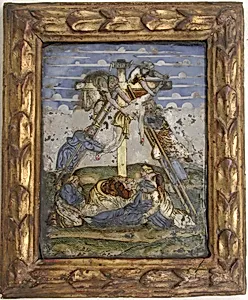
Descent from the Cross
Unknown Artist
16th century
Medium
Verre églomisé
Dimensions
8 1/8 × 6 1/2 in. (20.6 × 16.5 cm)
Classification
Glass-Painted
Culture
probably Austrian, probably Tyrol
Department
European Sculpture and Decorative Arts
Museum
Metropolitan Museum of Art, New York, NY
Credit
Gift of J. Pierpont Morgan, 1917
Accession Number
17.190.843
Rights
Public Domain
Tags
Art Historical Context
This poignant *Descent from the Cross*, a 16th-century verre églomisé panel likely from the Tyrol region of Austria, captures a sacred moment from the Passion of Christ. The scene depicts Jesus's body being tenderly lowered from the cross, surrounded by the grieving Virgin Mary and other figures, evoking profound sadness and devotion. Measuring just 8 1/8 × 6 1/2 inches, its intimate scale suggests it was crafted for private prayer or as part of a small altar ensemble. Verre églomisé, or reverse painting on glass, was a prized technique in Renaissance Europe, especially in Tyrolean workshops. Artists painted intricate details on the back of the glass—often layering gold leaf and metallic foils—creating a luminous, jewel-like glow when viewed from the front. This method protected the pigments from wear while enhancing the spiritual radiance of religious icons, making them ideal for homes during the Counter-Reformation's emphasis on personal piety. A gift to the Metropolitan Museum of Art from J. Pierpont Morgan in 1917, this rare surviving example highlights Tyrol's mastery of glass-painted decorative arts. Its vivid emotional depth invites visitors to reflect on faith, mortality, and artistic ingenuity in the Alpine heartland.