
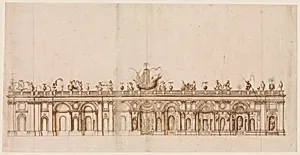
Design after a Fountain in the Villa Aldobrandini at Frascati.
1590–1600
Medium
Pen and brown ink, brush with brown wash and pale blue-gray watercolor accents (on the depictions of water), over leadpoint or black chalk, with ruling and compass construction
Dimensions
sheet: 13 5/8 x 26 3/4 in. (34.6 x 68 cm)
Classification
Drawings
Department
Drawings and Prints
Museum
Metropolitan Museum of Art, New York, NY
Credit
The Elisha Whittelsey Collection, The Elisha Whittelsey Fund, 1977
Accession Number
1977.619
Rights
Public Domain
Tags
Art Historical Context
Giovanni Guerra's *Design after a Fountain in Villa Aldobrandini Frascati* (c. 1590–1600) the grandeur of one of Renaissance Italy's most celebrated garden spectacles. The Villa Aldobrandini, perched in the hills near Rome, was a pinnacle of Mannerist landscaping, where engineering marvels like hydraulic fountains blended architecture, sculpture, and illusionistic water features. Guerra, a Bolognese artist active in Rome, meticulously rendered this design, likely as a study or record, highlighting the villa's innovative fountains adorned with architectural elements and nautical motifs like ships—evoking mythological seas amid terraced gardens. Executed on a large sheet (13⅝ × 26¾ in.), the drawing showcases Guerra's technical prowess through pen and brown ink over leadpoint or black chalk, enhanced by brown wash, pale blue-gray watercolor for shimmering water effects, and precise ruling with compass construction. This multi-layered technique, common in late 16th-century preparatory drawings, allowed for detailed planning of ephemeral installations that dazzled visitors with surprise and movement. Housed in The Metropolitan Museum of Art's Drawings and Prints department, this work offers a window into the opulent world of papal-era villas, where art and nature converged to symbolize power and ingenuity. It reminds us how such designs influenced European garden traditions for centuries.