
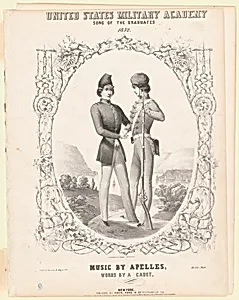
Design cover for West Point Song of the Graduates
Medium
Transfer lithograph in black on off-white wove paper
Dimensions
Image: 33.6 × 22.2 cm (13 1/4 × 8 3/4 in.); Sheet: 34.1 × 26.1 cm (13 7/16 × 10 5/16 in.)
Classification
transfer lithograph
Department
Prints and Drawings
Museum
Art Institute of Chicago
Accession Number
14482
Rights
Public Domain
Art Historical Context
James McNeill Whistler’s *Design Cover for West Point Song of the Graduates* (1852) is a delightful early print from the artist’s teenage years, capturing a moment of youthful creativity tied to his brief stint at the United States Military Academy at West Point. Created when Whistler was just 18 this cover design for a graduates’ songbook reflects the camaraderie and traditions of the academy, where he studied engineering before being dismissed for academic struggles—a pivot that launched his artistic path. Rendered as a transfer lithograph in bold black ink on off-white wove paper (image: 33.6 × 22.2 cm; sheet: 34.1 × 26.1 cm), the work showcases Whistler’s early mastery of lithography, a revolutionary 19th-century printing technique that allowed for fluid, painterly lines directly from drawings transferred onto stone. Housed in the Art Institute of Chicago’s Prints and Drawings department, it exemplifies the medium’s accessibility for book illustrations during the era’s print boom. Though Whistler would later gain fame for his Aesthetic movement paintings like *Whistler’s Mother*, this piece reveals his precocious talent for graphic design and printmaking, bridging American military culture with emerging fine art traditions. A hidden gem for visitors exploring 19th-century innovation!
About the Artist
James McNeill Whistler · 1834–1903
James Abbott McNeill Whistler (1834-1903) was an American-born painter and printmaker who became a leading figure in the Aesthetic Movement and pioneer of Tonalism and Japonisme. He revolutionized art by championing "art for art's sake" and treating paintings as visual equivalents of musical compositions, titling works as "arrangements," "harmonies," and "nocturnes" to emphasize formal qualities o...