
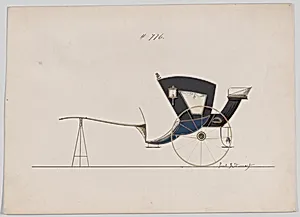
Design for 2 Wheeler, no. 776
Medium
Pen and black ink, watercolor and gouache
Dimensions
sheet: 6 1/8 x 8 5/8 in. (15.6 x 21.9 cm)
Classification
Drawings
Department
Drawings and Prints
Museum
Metropolitan Museum of Art, New York, NY
Credit
Gift of William Brewster, 1923
Accession Number
23.112.1896
Rights
Public Domain
Tags
Art Historical Context
Step into the elegant world of 19th-century coachmaking with *Design for 2 Wheeler no. 776*, a meticulous rendering by the renowned New York firm Brewster & Co., in collaboration with designer Paul Rodissart. between 1850 and 1874, this drawing depicts a sleek two-wheeled carriage—likely a lightweight buggy or sulky—tailored for speed and sophistication. Brewster & Co., founded in 1810, was America's premier carriage maker, crafting bespoke vehicles for the elite, from presidents to robber barons, embodying the Gilded Age's opulent mobility. Rendered in pen and black ink with watercolor and gouache on a modest 6 1/8 x 8 5/8-inch sheet, the work showcases the precision of drafting techniques used in industrial design. Fine ink lines delineate every curve, spoke, and harness, while vibrant gouache washes evoke polished wood, gleaming metal, and rich upholstery, bringing the vehicle to life. Such preparatory drawings were essential blueprints for master coachbuilders, highlighting the blend of artistry and engineering in pre-automobile transport. Today, this gem from the Metropolitan Museum of Art's Drawings and Prints department—generously gifted by William Brewster in 1923—offers a window into a vanishing craft. It reminds us how carriages were rolling status symbols, precursors to modern luxury autos, preserved as both technical marvels and cultural artifacts.
About the Artist
Brewster & Co.|Paul Rodissart · 1837–present
**Brewster & Co.** Brewster & Company, a premier American coachbuilder renowned for its exquisite carriage designs, was established in 1810 in New Haven, Connecticut, by James Brewster (1788–1866). Born in 1788, Brewster trained as a wagonmaker's apprentice starting at age 16 in Northampton, Massachusetts, before relocating to New Haven, where he set up his workshop and quickly gained acclaim for...