
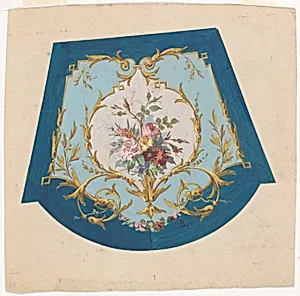
Design for a Chair Seat Cover
ca. 1850–70
Medium
Pen and ink and watercolor
Dimensions
5 9/16 x 5 11/16 in. (14.2 x 14.5 cm)
Classification
Drawings|Ornament & Architecture
Department
Drawings and Prints
Museum
Metropolitan Museum of Art, New York, NY
Credit
Gift of William Rieder, 2009
Accession Number
2009.465.6
Rights
Public Domain
Tags
Art Historical Context
This delicate *Design for a Chair Seat*, created by an anonymous French artist around 1850–70, captures the ornate spirit of mid-19th decorative arts. Rendered in pen and ink with watercolor on a modest 5 9/16 x 5 11/16-inch sheet, it features intricate floral and leaf motifs—hallmarks of the era's love for nature-inspired embellishment. Such preparatory drawings were essential tools for artisans, guiding the production of luxurious upholstery for bourgeois homes during France's Second Empire under Napoleon III. The work exemplifies the period's revival of historic styles, blending Rococo flourishes with emerging eclecticism, as seen in the precise ink lines defining petals and foliage, softened by vibrant watercolor washes. These techniques allowed designers to convey texture and color accurately, bridging the gap between sketch and finished textile. Classified in the Metropolitan Museum of Art's Drawings and Prints department as Ornament & Architecture, it highlights how everyday furniture became canvases for artistic expression. A gift of William Rieder in 2009, this anonymous gem offers a glimpse into the unsung craft of 19th-century design, where floral abundance symbolized prosperity and refined taste in Parisian interiors.
About the Artist
Anonymous, French, 19th century · 1800–1900
**Anonymous, French, 19th Century (ca. 1800–1900)** The artist cataloged as Anonymous, French, 19th century embodies the enigmatic yet essential contributions of unidentified creators to France's vibrant 19th-century art world. Active roughly between 1800 and 1900, this figure—or potentially collective workshop—produced a diverse array of works amid the nation's transition from Neoclassicism thro...