
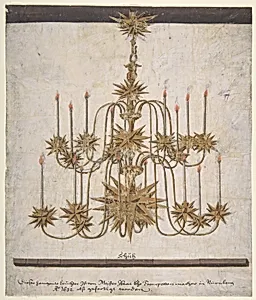
Design for a Chandelier with Sixteen Candles
1632
Medium
Brush and brown, ochre, and gold paint, touches of orange and blue gouache, over a preliminary sketch in gray gouache(?) on vellum prepared with white.
Dimensions
sheet: 11 7/8 x 10 1/16 in. (30.1 x 25.6 cm)
Classification
Drawings|Ornament & Architecture
Department
Drawings and Prints
Museum
Metropolitan Museum of Art, New York, NY
Credit
Harris Brisbane Dick Fund, 1953
Accession Number
53.600.32
Rights
Public Domain
Art Historical Context
### Design for a Chandelier with Sixteen Candles Created in 1632 by Isaak Ehe, a master goldsmith from the renowned Ehe family of Augsburg, Germany, this exquisite drawing is a preparatory design for an opulent chandelier featuring sixteen candles. During the Baroque era, amid the grandeur of Central European courts and churches, such designs captured the period's love for dramatic light and lavish ornamentation. Augsburg was a hub for intricate metalwork, and Ehe's blueprint would have guided silversmiths in crafting a fixture to illuminate sacred spaces or noble halls, symbolizing divine radiance. The artwork's medium—brush and brown, ochre, and gold paints with touches of orange and blue gouache over a gray preliminary sketch on white-prepared vellum—highlights its technical sophistication. Vellum, a fine parchment from animal skin, allowed for precise, luminous details that mimicked the sheen of polished silver or gold. The layered gouache technique builds depth and sparkle, foreshadowing the chandelier's intricate scrolls, arms, and candle cups in a style blending Mannerist elegance with emerging Baroque exuberance. Housed in The Metropolitan Museum of Art's Drawings and Prints department (Harris Brisbane Dick Fund, 1953), this 11⅞ × 10¹/₁₆-inch sheet offers a rare glimpse into 17th-century design processes, revealing how artists like Ehe bridged sketch and splendor. Imagine it flickering to life in a candlelit cathedral—a testament to craftsmanship that turned light into art.