
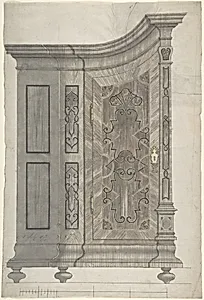
Design for a Concave Corner Cabinet (Possibly Part of a Larger Wall-Covering Unit)
ca. 1730–40
Medium
Pen and black ink, brush and gray and brown wash, watercolor, traces of ruled graphite lines
Dimensions
sheet: 14 1/8 x 9 5/8 in. (35.8 x 24.5 cm)
Classification
Drawings|Ornament & Architecture
Department
Drawings and Prints
Museum
Metropolitan Museum of Art, New York, NY
Credit
Gift of János Scholz, 1942
Accession Number
42.53.56
Rights
Public Domain
Tags
Art Historical Context
This delicate drawing, created by an anonymous German artist 1730–40, presents a refined design for a concave corner cabinet, likely intended part of a grander wall-covering furniture ensemble. Emerging during the height of the Rococo era in Germany, such designs emphasized elegant curves, asymmetry, and intricate ornamentation to harmonize with opulent interiors of palaces and wealthy homes. The concave form was particularly ingenious for optimizing awkward corner spaces, blending functionality with lavish decoration. Executed on a modest sheet measuring 14 1/8 x 9 5/8 inches, the work showcases masterful drafting techniques: precise pen and black ink outlines, enhanced by subtle gray and brown washes for depth and shadowing, touches of watercolor for vibrancy, and faint ruled graphite lines for architectural accuracy. These methods were standard in 18th-century workshops, allowing designers to visualize complex cabinetry before costly woodwork began. Today, housed in the Metropolitan Museum of Art's Drawings and Prints department as a 1942 gift from János Scholz, this anonymous gem offers a window into the collaborative world of Baroque-Rococo craftsmanship, where drawings like this bridged artistry and artisanship in Europe's furniture golden age.