
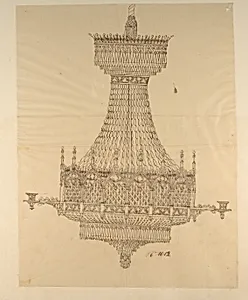
Design for a Crystal Chandelier
19th century
Medium
Pen and brown ink
Dimensions
sheet: 15 5/16 x 12 1/16 in. (38.9 x 30.7 cm)
Classification
Drawings
Department
Drawings and Prints
Museum
Metropolitan Museum of Art, New York, NY
Credit
Rogers Fund, 1966
Accession Number
66.631.77
Rights
Public Domain
Tags
Art Historical Context
This delicate pen and brown ink drawing, titled *Design for a Crystal Chand*, captures the opulent spirit of 19th-century France. Created by an anonymous artist, it sketches an intricate lighting fixture destined for grand interiors—perhaps a lavish Parisian salon, theater, or hôtel particulier. Measuring 15 5/16 x 12 1/16 inches, the sheet showcases the meticulous planning behind luxury decorative arts, where such designs bridged the gap between imagination and craftsmanship. In the 19th century, amid France's Industrial Revolution and imperial splendor under Napoleon III, crystal chandeliers symbolized wealth and refinement. Gas and early electric lighting fueled innovation in these fixtures, blending cut-glass prisms with ornate metalwork for dazzling effects. This anonymous work, now in the Metropolitan Museum of Art's Drawings and Prints department (acquired via the Rogers Fund in 1966), exemplifies the era's design drawings—preliminary blueprints valued for their precision and flair. The use of pen and brown ink allowed for fine lines and subtle shading, ideal for conveying the chandelier's tiers, pendants, and scrolls. These techniques highlighted transparency and sparkle, inviting artisans to realize the vision in glittering crystal. A testament to France's enduring legacy in decorative design, it reminds us how everyday sketches fueled the glow of high society.
About the Artist
Anonymous, French, 19th century · 1800–1900
**Anonymous, French, 19th Century (ca. 1800–1900)** The artist cataloged as Anonymous, French, 19th century embodies the enigmatic yet essential contributions of unidentified creators to France's vibrant 19th-century art world. Active roughly between 1800 and 1900, this figure—or potentially collective workshop—produced a diverse array of works amid the nation's transition from Neoclassicism thro...