
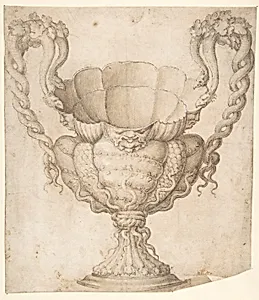
Design for a Decorated Drinking Cup with Floriated Heads around Large Mouth, Intertwined Serpents as Handles
n.d.
Medium
Pen and brown ink, brush and brown wash over traces of black chalk; small corrections in white gouache
Dimensions
Sheet: 9 15/16 x 8 9/16 in. (25.2 x 21.7 cm)
Classification
Drawings|Ornament & Architecture
Department
Drawings and Prints
Museum
Metropolitan Museum of Art, New York, NY
Credit
Purchase, Harris Brisbane Dick Fund and Joseph Pulitzer Bequest, 1971
Accession Number
1971.513.16
Rights
Public Domain
Tags
Art Historical Context
Giulio Romano, a leading figure of the Mannerist movement and former pupil of Raphael, created this intricate design for an ornate drinking cup in the 16th century. Known for blending classical motifs with imaginative exaggeration, Romano often produced such ornamental drawings for courtly patrons in Mantua and beyond. The sheet captures his flair for the grotesque, featuring floriated heads encircling the cup’s wide mouth and serpents intertwined as handles—elements that evoke both ancient Roman symbolism of transformation and the playful, fantastical spirit of Mannerist decoration. Executed in pen and brown ink with brush washes over black chalk, the drawing reveals Romano’s masterful technique for conveying volume, shadow, and texture on a modest scale. Small corrections in white gouache highlight the iterative nature of his process, typical of Renaissance design work intended for goldsmiths or sculptors to follow. These preparatory studies were essential in an era when luxury objects served as status symbols, bridging fine art and the decorative arts. Housed in the Metropolitan Museum of Art’s Department of Drawings and Prints, this work underscores the cultural importance of ornament in Renaissance courts, where such vessels symbolized wealth, wit Status, and a revival of classical mythology. Its serpentine forms and floral details invite viewers to appreciate how artists like Romano transformed functional items into narrative sculptures.
About the Artist
Giulio Romano · 1499–1546
Giulio Romano (c. 1499–1546) was the most gifted pupil of Raphael and one of the founding figures of Mannerism, the style that succeeded the High Renaissance in Italy. Born Giulio Pippi in Rome, he entered Raphael's workshop as a boy and proved so talented that by the time of Raphael's death in 1520 he was effectively running the studio and overseeing the completion of major unfinished commissions...