
Design for a Facade
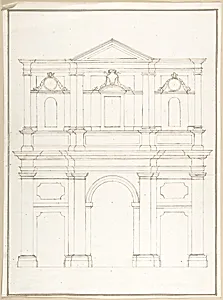
Medium
Pen and brown ink, over ruling in graphite
Dimensions
17-1/4 x 12-3/4 in. (43.8 x 32.4 cm)
Classification
Drawings
Department
Drawings and Prints
Museum
Metropolitan Museum of Art, New York, NY
Credit
The Elisha Whittelsey Collection, The Elisha Whittelsey Fund, 1960
Accession Number
60.632.38
Rights
Public Domain
Tags
Art Historical Context
Step into the intricate world of 18th-century Italian architecture with *Design for a Facade* by Pietro Paolo Coccetti (also known as Cocchetti), a Roman architect active during the late Baroque era. Created between 1710 and 1727, this preparatory drawing captures the artist's vision for a grand building front, rendered in meticulous pen and brown ink over subtle graphite rulings. Measuring 17-1/4 x 12-3/4 inches (43.8 x 32.4 cm), it exemplifies the precision required for monumental projects in an age of opulent palaces and churches. The medium highlights a key technique of the period: graphite rulings provided a structural underdrawing, allowing the brown ink to add dynamic lines, shadows, and ornamental flourishes. Such sheets were essential tools for architects pitching designs to patrons, blending mathematical accuracy with artistic flair amid Rome's architectural boom under papal influence. Coccetti's work reflects the era's emphasis on dramatic facades that conveyed power and piety. Today, this gem from The Metropolitan Museum of Art's Drawings and Prints department—acquired through The Elisha Whittelsey Collection in 1960—invites us to appreciate the unseen labor behind enduring structures. It reminds visitors how a simple sketch could birth architectural icons, bridging creativity and construction in Baroque Europe.
About the Artist
Pietro Paolo Coccetti (Cocchetti) · 1710–1727
Pietro Paolo Coccetti, also recorded as Cocchetti, was an Italian artist whose career was brief by any measure — the dates associated with him span only the years 1710 to 1727, suggesting either a very short life or a period of documented activity that represents only a fraction of his actual career. He worked within the Italian tradition of the eighteenth century, a period of great vitality in th...