
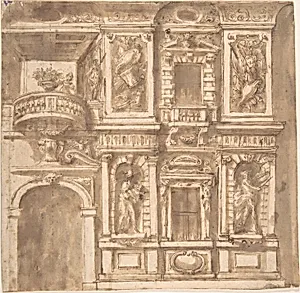
Design for a Facade with Statues in Niches and Armorial Trophies
17th century
Medium
Pen and brown ink, brush and brown wash, over graphite underdrawing
Dimensions
sheet: 8 9/16 x 8 13/16 in. (21.8 x 22.4 cm)
Classification
Drawings|Ornament & Architecture
Department
Drawings and Prints
Museum
Metropolitan Museum of Art, New York, NY
Credit
The Elisha Whittelsey Collection, The Elisha Whittelsey Fund, 1952
Accession Number
52.570.125
Rights
Public Domain
Tags
Art Historical Context
This exquisite 17th-century drawing, created by an anonymous Italian artist, presents a dynamic design for a building facade adorned with statues set in deep niches and elaborate armorial trophies. Rendered on a modest sheet measuring about 8½ by 8¾ inches, it captures the grandeur typical of Baroque architecture in Italy during this era—a time when facades served as dramatic stages for symbolism, power, and piety. Such designs were often preparatory sketches for palaces, churches, or civic structures, blending sculpture and ornament to create visual spectacle. The artist's technique exemplifies the precision of period draftsmen: a faint graphite underdrawing lays out the composition, followed by fluid pen lines in brown ink for crisp architectural details, and subtle brushwork with brown wash to model shadows and depth. This layered approach mimics stone's texture and light play, making the flat paper evoke three-dimensional stonework. Armorial trophies—wreaths, shields, and weapons—hint at heraldic pride, possibly for a noble family or commemorative monument. Housed in the Metropolitan Museum of Art's Elisha Whittelsey Collection, this anonymous gem offers a window into the collaborative workshops of Italy's golden age of design, where innovation in ornament elevated everyday architecture into art. Visitors will appreciate its intricate detail, a testament to the era's fusion of engineering and embellishment.