
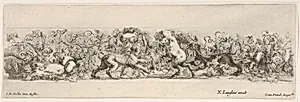
Design for a Frieze with Putti carrying a Vine and Three Felines, Plate 11 from: 'Decorative friezes and foliage' (Ornamenti di fregi e fogliami)
ca. 1645–50
Medium
Etching
Dimensions
Sheet: 3 3/8 × 9 13/16 in. (8.5 × 25 cm)
Classification
Prints|Ornament & Architecture
Department
Drawings and Prints
Museum
Metropolitan Museum of Art, New York, NY
Credit
Bequest of Phyllis Massar, 2011
Accession Number
2012.136.100.7
Rights
Public Domain
Tags
Art Historical Context
This delightful etching, *Design for a Frieze with Putti a Vine and Three F*, is Plate 11 from Stefano della Bella's *Decorative Friezes and Foliage* (*Ornamenti di freg e fogliami*), around 1645–50. printmaker Stefano della Bella, renowned for his intricate Baroque designs, captures playful putti—those cherubic child figures symbolizing joy and abundance—hoisting a lush vine, accompanied by three lively felines. Published by Nicolas Langlois the print measures a modest 3 3/8 × 9 13/16 inches, perfect for architectural ornamentation. Della Bella's etching technique shines here, with fine, fluid lines etched into a metal plate using acid, allowing for exquisite detail in the twisting vines, furred cats, and dynamic poses. During the Baroque era, such frieze designs adorned palaces and churches, blending natural motifs with mythological whimsy to evoke movement and vitality. This work exemplifies the period's love for elaborate decoration, influencing European ornamental arts from Italy to France. A bequest to the Metropolitan Museum of Art in 2011, this print invites us to appreciate how 17th-century artists like della Bella turned everyday fantasy into timeless elegance, bridging art and architecture for grand interiors.
About the Artist
Stefano della Bella|Nicolas Langlois · 1610–1664
Stefano della Bella (1610-1664) was one of the most prolific and versatile printmakers of the Italian Baroque period, leaving behind 1,052 prints and several thousand drawings that captured the vivid essence of 17th-century European life. Born in Florence on May 18, 1610, to a family of artists, he trained initially as a goldsmith before studying painting under Cesare Dandini and etching under Rem...