
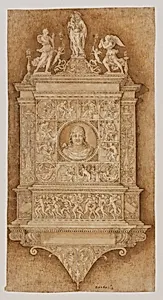
Design for a Funeral Monument
early 16th century
Medium
Pen and ink in two shades of brown, brush and brown washes.
Dimensions
11 5/8 x 6 1/16 in. (29.6 x 15.4 cm)
Classification
Drawings
Culture
Italian, Lombard
Department
Robert Lehman Collection
Museum
Metropolitan Museum of Art, New York, NY
Credit
Robert Lehman Collection, 1975
Accession Number
1975.1.419
Rights
Public Domain
Tags
Art Historical Context
This exquisite *Design for a Funeral Monument from early 16th-century Lomb captures the Renaissance fusion of piety and classical grandeur. Likely intended for a noble or ecclesiastical patron, it features a Madonna and Child enthroned atop an ornate sarcophagus, flanked by male figures— saints, mourners, or allegorical attendants—evoking eternal salvation amid the somber theme of death. Lombard artists, influenced by Leonardo da Vinci's stay in Milan, excelled in such preparatory drawings, blending Northern Italian naturalism with antique motifs revived during the Renaissance. Crafted in pen and ink with two shades of brown and subtle brown washes, the sheet measures a compact 11 5/8 x 6 1/16 inches, showcasing masterful techniques for modeling form and depth. The fine lines delineate architectural details like pilasters and niches, while washes add volumetric shadow, simulating the marble sculpture it previews. This medium was prized for its precision, allowing architects and sculptors to refine commissions before costly execution. Housed in the Robert Lehman Collection at The Metropolitan Museum of Art, this Lombard drawing highlights the era's cultural reverence for funerary art as a bridge between earthly legacy and divine grace, offering visitors a window into the inventive workshops of Renaissance Italy.