
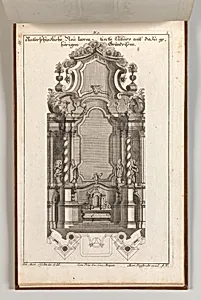
Design for a Monumental Altar, Plate i from 'Unterschiedliche Neu Inventierte Altäre mit darzu gehörigen Profillen u. Grundrißen.'
Printed ca. 1750–56
Medium
Etching
Dimensions
Overall: 8 7/16 × 13 3/4 in. (21.5 × 35 cm)
Classification
Prints|Ornament & Architecture|Albums
Department
Drawings and Prints
Museum
Metropolitan Museum of Art, New York, NY
Credit
Purchase, Daniel Ergmann Gift, 2014
Accession Number
2014.97.115
Rights
Public Domain
Tags
Art Historical Context
This exquisite etching, *Design for a Monumental, Plate i* from Johann Michael Leüchte and Engelbrecht's album *Unterschiedliche Neuierte Altäre mit darzu gehörigen Profillen. Grundrißen* (ca. 1750–56), showcases an elaborate Baroque-inspired altar design destined for grand ecclesiastical spaces. Printed on a modest sheet measuring 8 7/16 × 13 3/4 inches, it features intricate architectural details, profiles, and ground plans, builders and artisans to replicate its soaring columns, sculpted niches, and ornate baldachin. Created during the Rococo era in German-speaking Europe, this plate exemplifies the period's passion for opulent church furnishings amid Catholic Counter-Reformation fervor. Leüchte, likely the designer, and Engelbrecht, a prolific engraver known for ornamental prints, produced these "newly invented" patterns as practical models for workshops, democratizing sophisticated altar architecture through reproducible etchings—a technique prized for its fine lines and tonal depth. Housed in the Metropolitan Museum of Art's Drawings and Prints department (Purchase, Daniel Ergmann Gift, 2014), this work highlights how printed albums bridged artistic innovation and craftsmanship, shaping sacred interiors across 18th-century Europe. Visitors will appreciate its blend of grandeur and precision, a window into the era's devotional splendor.