
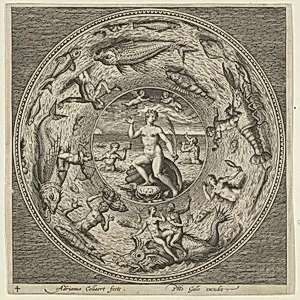
Design for a Plate with Galatea on a Shell Flanked by Trumpeters in a Medallion Bordered by Sea Monsters
ca. 1600
Medium
Engraving
Dimensions
Sheet: 6 5/8 × 6 9/16 in. (16.8 × 16.6 cm)
Classification
Ornament & Architecture|Prints
Department
Drawings and Prints
Museum
Metropolitan Museum of Art, New York, NY
Credit
Rogers Fund, 1917
Accession Number
17.80.2(4)
Rights
Public Domain
Tags
Art Historical Context
This exquisite engraving, titled *Design for a Plate with Galatea a Shell Flanked byeters in a Medallioned by Sea Monsters*, created around 1600 by Flemish artists Adriaen Colla and Philips Galle. As collaborative effort from Antwerp's vibrant printmaking scene, it exemplifies the Northern Mannerist style, where intricate details and fantastical motifs adorned designs for luxury objects like silverware or ceramics Measuring just over 6 inches square, the sheet captures a medallion centerpiece featuring the sea nymph Galatea—drawn from Ovid's *Metamorphoses*—poised gracefully on a shell, heralded by trumpeting figures and encircled by grotesque sea monsters and fish. Engravings like this were pivotal in the late Renaissance, serving as models for artisans across Europe to replicate elaborate decorative patterns. Collaert and Galle, masters of the burin technique, incised fine lines into copper plates to produce precise, reproducible images that blended classical mythology with whimsical marine imagery. The mythical creatures evoke the era's fascination with the grotesque and the sea's mysteries, reflecting Antwerp's role as a hub for ornamental prints that influenced goldsmiths and potters. Today, housed in the Metropolitan Museum of Art's Drawings and Prints department (Rogers Fund, 1917), this work invites visitors to appreciate how Renaissance ingenuity transformed everyday tableware into storytelling canvases teeming with wonder.